
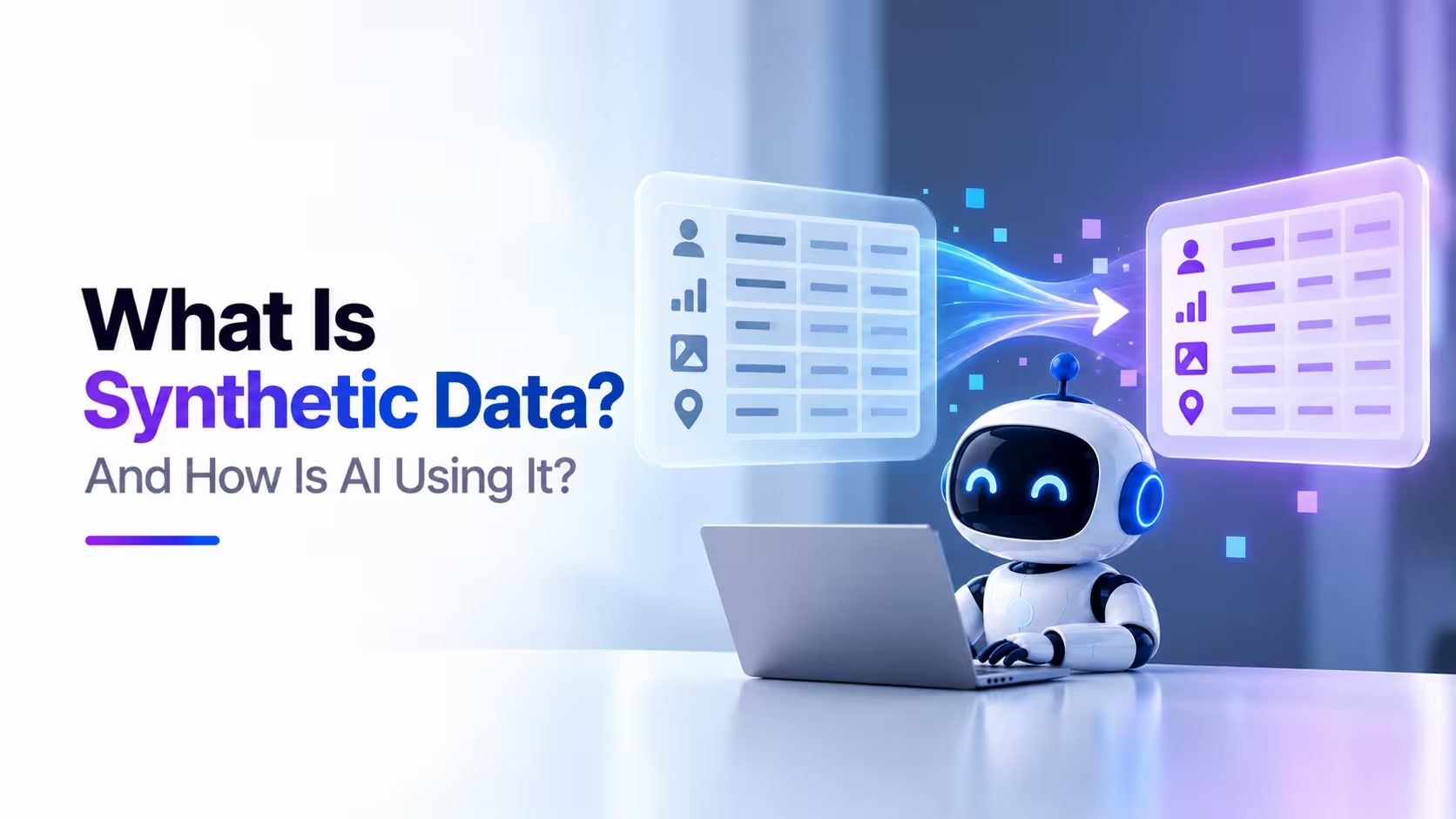
Synthetic data is artificially generated data that is designed to resemble real-world data. Instead of collecting every example from real people, devices, transactions, or environments, organizations can use algorithms and AI to create realistic datasets for testing, training, research, and development.
Synthetic data has become increasingly important as AI systems require large amounts of data. It can help organizations create additional training examples, simulate rare situations, protect sensitive information, and test AI systems in controlled environments.
But synthetic data is not simply "fake data." Good synthetic data needs to preserve useful patterns from real-world data while avoiding unnecessary exposure of the original information.
Let's look at what synthetic data is, how it works, and how AI is using it.
What Is Synthetic Data?
Synthetic data is data generated artificially rather than directly collected from real-world events or individuals. It can be generated using statistical models, machine learning systems, simulations, or generative AI.
For example, imagine a company wants to train an AI system to recognize different types of vehicles. Instead of collecting thousands of real photographs, it could generate synthetic images showing:
- Cars
- Trucks
- Buses
- Motorcycles
- Different weather conditions
- Different lighting conditions
- Different camera angles
The generated images can then be used as additional training data.
The same concept can be applied to many other types of information.
Examples of Synthetic Data
Synthetic data can include text, images, video, audio, customer records, financial transactions, sensor readings, healthcare records, product data, software logs, and geographical data.
So synthetic data isn't limited to one particular format.
Why Do We Need Synthetic Data?
AI systems often need large and diverse datasets to perform well. However, collecting real-world data can be difficult. There may be problems involving:
- Privacy
- Cost
- Data availability
- Rare events
- Data imbalance
- Legal restrictions
- Security
- Manual labeling
Synthetic data can help address some of these challenges.
For example, suppose a company is developing an autonomous driving system. It may be relatively easy to collect normal driving footage. But collecting thousands of examples of unusual or dangerous situations is much harder. A simulation could generate scenarios such as:
Normal road → heavy rain → pedestrian crossing → unusual vehicle movement
This gives developers additional situations to test without waiting for those events to happen naturally.
How Is Synthetic Data Created?
There isn't one single method for generating synthetic data. Different approaches are used depending on the type of data and the intended purpose.
1. Statistical Models
Traditional statistical techniques can generate new data based on patterns found in existing datasets. For example, if a dataset contains information about customer purchases, a statistical model could generate additional records with similar characteristics.
2. Machine Learning Models
Machine learning models can learn patterns from existing datasets and generate new examples. The generated data can resemble the statistical properties of the original data without directly copying individual records.
3. Generative AI
Modern generative AI has made synthetic data generation much more flexible. Generative models can create realistic images, text, audio, video, structured records, and simulated environments.
For example, an image-generation model could produce thousands of variations of the same object under different lighting and backgrounds.
4. Simulation
Simulations can generate synthetic data by recreating an environment digitally. This is particularly useful in areas such as robotics, autonomous vehicles, manufacturing, healthcare research, weather modeling, and industrial systems.
A virtual environment can produce huge amounts of data without requiring the physical environment to be available for every experiment.
Synthetic Data vs Real Data
Synthetic data and real-world data serve different purposes.
| Real Data | Synthetic Data |
|---|---|
| Collected from real events | Artificially generated |
| Represents actual observations | Designed to resemble real observations |
| Can contain sensitive information | Can potentially reduce exposure to sensitive information |
| Collection can be expensive | Can often be generated at scale |
| Rare events can be difficult to capture | Rare scenarios can be deliberately generated |
| May require extensive cleaning | Can be generated with controlled characteristics |
Synthetic data doesn't automatically replace real data.
In many AI projects, the two can be used together.
How Is AI Using Synthetic Data?
AI is one of the biggest areas where synthetic data is being used.
1. Training AI Models
AI models need examples to learn patterns. Synthetic data can provide additional examples when real datasets are limited.
For example, an AI vision system could be trained using synthetic images of objects from different angles, environments, and lighting conditions. This can increase the variety of training examples available to the model.
2. Creating Rare Examples
Some events happen too rarely to provide enough real training data. Consider an AI system designed to detect manufacturing defects. A factory may have thousands of examples of normal products but relatively few examples of serious defects.
Synthetic data can be used to create additional examples of specific defect types. This can help developers test whether an AI system can recognize unusual situations.
3. Testing AI Systems
Synthetic data can also be useful for testing. Developers can deliberately create specific scenarios and see how an AI system responds. For example:
Input → unusual situation → AI prediction → expected behavior
This can help identify weaknesses before deploying a system in the real world.
Synthetic Data in Computer Vision
Computer vision is one of the areas where synthetic data can be particularly useful. Imagine you're developing an AI system that detects objects in warehouses. Instead of photographing every possible warehouse environment, synthetic images can be generated with different objects, camera positions, lighting conditions, backgrounds, occlusions, and object sizes.
This creates a larger variety of examples for the computer vision model.
Synthetic environments are also useful in robotics and autonomous systems, where collecting real-world training data can be expensive or dangerous.
Synthetic Data in Healthcare
Healthcare is another important area for synthetic data. Medical datasets can contain highly sensitive information, making access and sharing complicated.
Synthetic healthcare data can potentially be used for research, software development, testing, medical AI development, data analysis, and education.
For example, researchers could create synthetic patient records containing realistic relationships between different variables without using a specific person's actual medical record.
However, synthetic healthcare data still needs careful validation. A dataset being synthetic doesn't automatically guarantee that it is private, accurate, or suitable for a particular medical use.
Synthetic Data in Finance
Financial organizations can use synthetic data to simulate different transaction patterns. Possible applications include fraud detection, risk modeling, testing financial software, payment simulations, cybersecurity testing, and customer behavior modeling.
For example, developers could generate simulated transactions containing different combinations of normal and suspicious activity.
This can help test fraud-detection systems without relying exclusively on sensitive real transaction data.
Synthetic Data for Autonomous Vehicles
Autonomous driving systems need to understand a huge variety of road situations. Synthetic environments can simulate roads, cars, pedestrians, traffic signals, weather, night driving, construction zones, and unusual road situations.
This allows developers to test systems in scenarios that may be difficult or unsafe to reproduce in the real world.
Synthetic data can therefore complement real driving data rather than completely replace it.
Synthetic Data and Generative AI
Generative AI has made synthetic data generation significantly more accessible. A generative model can create new examples based on patterns learned from existing information. For example:
Real dataset → AI learns patterns → synthetic examples → model training/testing
This creates an interesting feedback loop. AI can use data to learn, and AI can also help create additional data for training other AI systems.
However, this introduces an important question: what happens if AI-generated data is repeatedly used to train future AI models?
This is one reason data quality and provenance matter.
What Are the Benefits of Synthetic Data?
- Scalability: Large datasets can be generated much faster than manually collecting every example.
- Privacy: Synthetic data can reduce the need to directly share certain real-world records, although privacy must still be evaluated rather than assumed.
- Control: Developers can deliberately create particular scenarios or data distributions.
- Rare Events: Unusual situations can be generated more easily than waiting for them to occur naturally.
- Lower Collection Costs: Generating data digitally can sometimes be cheaper than collecting and labeling large real-world datasets.
- Faster Testing: Development teams can create test datasets specifically designed to evaluate particular system behaviors.
What Are the Risks of Synthetic Data?
Synthetic data isn't a perfect solution.
Synthetic Data Can Contain Bias
If the original data contains biases, a model trained on that data may reproduce those patterns in synthetic outputs. The generation process itself can also introduce new biases.
Synthetic Data Can Be Inaccurate
Synthetic data may look realistic while still failing to represent important real-world relationships. For example, a synthetic customer dataset might appear realistic but contain unrealistic combinations of attributes.
That can make the resulting AI model less reliable.
Synthetic Data Can Become Too Similar
If generated data lacks enough diversity, an AI model may learn a narrow representation of the problem. This is particularly important when generating large quantities of training data.
Synthetic Doesn't Automatically Mean Private
One common misconception is: synthetic data = automatically anonymous. That's not necessarily true.
If a generation process reproduces information too closely or leaks details from its source data, privacy concerns can remain.
Organizations therefore need appropriate privacy and security testing.
Can Synthetic Data Replace Real Data?
Usually, synthetic data works best as a complement to real-world data rather than a complete replacement. Real data provides observations from the actual environment. Synthetic data can then help expand, balance, simulate, or test those observations. A practical approach can look like:
Real Data + Synthetic Data + Validation → AI Model
The right balance depends on the application. For safety-critical or highly regulated systems, developers may need extensive real-world validation even when synthetic data is used heavily during development.
Synthetic Data vs Augmented Data
These terms are sometimes confused.
Data Augmentation
Data augmentation takes an existing example and modifies it. For example:
Original image → crop → rotate → brightness change
The resulting image is still based directly on the original example.
Synthetic Data
Synthetic data is generated as a new example based on a model, simulation, or generation process. For example:
Learned patterns → generate a new image
Both approaches can increase dataset diversity, but they work differently.
The Future of Synthetic Data
As AI systems become more capable, synthetic data is likely to become increasingly important. Future applications may involve more realistic simulations, AI-generated training environments, synthetic robotics data, synthetic video datasets, personalized simulations, large-scale software testing, autonomous systems, AI model evaluation, and privacy-conscious data sharing.
The biggest opportunity isn't simply generating more data.
It's generating useful, diverse, representative, and trustworthy data. For AI developers, that distinction matters.
Frequently Asked Questions
What is synthetic data in simple terms?
Synthetic data is artificially generated information designed to resemble real-world data.
Is synthetic data real data?
No. Synthetic data isn't directly collected from real-world events, although it can be generated to reproduce patterns found in real data.
Why is synthetic data useful for AI?
It can provide additional training examples, simulate rare situations, support testing, and potentially reduce reliance on sensitive or difficult-to-collect real-world data.
Is synthetic data safe?
It can be useful for privacy and security, but synthetic data is not automatically safe or anonymous. Its generation process and output should be evaluated.
Can AI generate synthetic data?
Yes. Generative AI and other machine learning techniques can generate synthetic text, images, audio, video, structured datasets, and simulated environments.
Can synthetic data improve AI models?
It can, particularly when it adds useful diversity or represents scenarios that are difficult to capture with real data. However, poor-quality synthetic data can also hurt model performance.
Final Thoughts
Synthetic data is becoming an important part of modern AI development.
Instead of relying entirely on information collected from the real world, developers can use AI, machine learning, and simulations to create additional data for training, testing, and experimentation.
Its value isn't simply in producing huge amounts of artificial information. The real benefit comes from creating data that is representative, diverse, useful, and properly validated.
As AI models continue to require more data and more complex testing environments, synthetic data will likely become an increasingly important part of the AI development process.
Want to explore more of what's next in AI?
At Aivellow, we're following these developments closely and helping users discover AI tools across productivity, marketing, coding, content creation, research, automation, and more. Check out our What Are AI Agents guide and our AI Trends to Watch in 2026. See our full Top 25 Best AI Tools in 2026 guide and our ChatGPT vs Claude vs Gemini comparison, browse our Top AI Productivity Tools and 15 Best AI Coding Assistants guides, explore more by category, submit a tool we should feature, or get in touch if you have questions.