
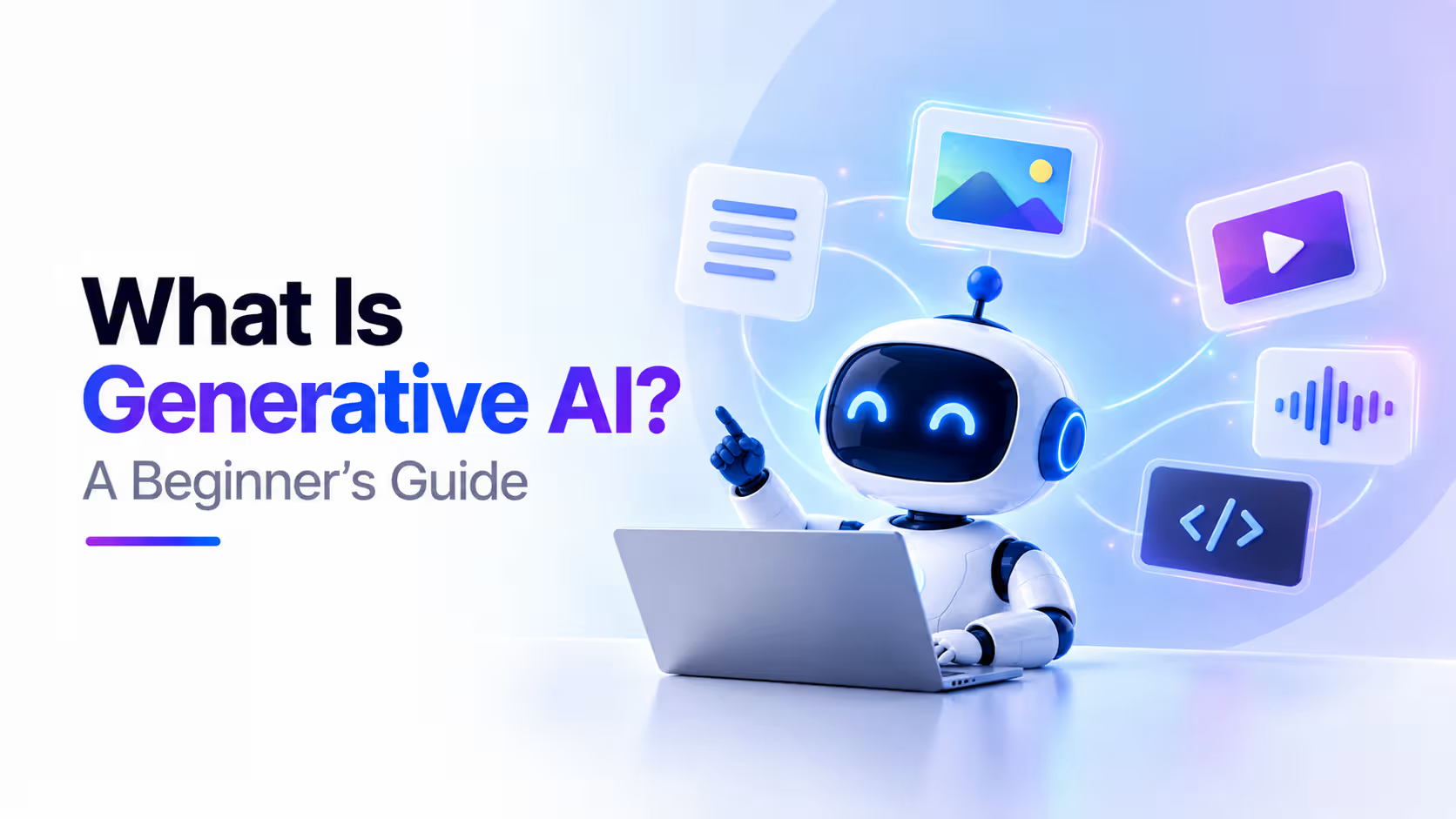
Generative AI has quickly become one of the most talked-about areas of artificial intelligence. Whether you're using ChatGPT to write something, generating an image from a simple prompt, creating a video, or asking AI to help with code, you're already seeing generative AI in action.
But what exactly is generative AI, how does it work, and what makes it different from traditional AI?
In this beginner-friendly guide, we'll break down generative AI in simple terms, look at how it works, explore real-world examples, and explain where it's being used today.
What Is Generative AI?
Generative AI is a type of artificial intelligence that can create new content based on patterns it has learned from existing data.
Instead of simply analyzing information or following a fixed set of rules, generative AI can produce things such as:
- Text
- Images
- Videos
- Audio
- Music
- Computer code
- Presentations
- Summaries
- Product descriptions
- Other forms of digital content
For example, you could ask an AI tool: "Write a short product description for a wireless Bluetooth speaker."
The AI can generate a new description based on your instructions.
That's the key idea behind generative AI: you provide an input, and the system generates an output.
How Does Generative AI Work?
Generative AI systems are trained using very large amounts of data. During training, the AI model learns patterns, relationships, structures, and characteristics within that data.
For example, a language model can learn patterns in text, including how sentences are structured, how words relate to one another, different writing styles, common questions and answers, programming patterns, and relationships between concepts.
When you give the model a prompt, it uses what it learned to generate a response.
A Simple Example
Imagine asking an AI: "Write a social media post about a new coffee shop." The basic process looks like this:
Your prompt → AI model → Generated content
The model interprets your request and generates text that matches the context and instructions you provided.
Modern generative AI systems can do much more than simple text generation. Depending on the model, they can work with multiple types of information, including text, images, audio, and video.
What Can Generative AI Create?
Generative AI is not limited to writing. Different AI models specialize in different types of content.
1. Text
Text-generation tools can help create blog posts, emails, social media captions, product descriptions, reports, summaries, marketing copy, stories, and research drafts.
Tools such as ChatGPT and Claude are examples of AI systems that can generate and work with text.
2. Images
Image-generation models can create images from written descriptions. For example: "A futuristic city at night with glowing skyscrapers and flying cars."
The system can generate an image based on that description. Image generation is being used for advertising, website graphics, concept art, social media, product concepts, presentations, and creative projects.
3. Video
Generative AI can also create or modify video content. Depending on the tool, users can generate video from text prompts, transform existing footage, create visual effects, or produce short marketing videos.
This is particularly useful for content creators, marketers, and businesses that need video content regularly.
4. Audio and Voice
AI can generate speech, sound, music, and other types of audio. Businesses and creators use these technologies for voiceovers, podcasts, audiobooks, video narration, virtual assistants, music creation, and accessibility tools.
5. Code
Generative AI has also become useful for software development. AI coding tools can help developers generate code, explain existing code, find bugs, write tests, refactor code, create documentation, and understand unfamiliar projects.
This doesn't mean developers can always accept generated code without checking it. Human review is still important, especially for production software.
Generative AI vs Traditional AI
One of the easiest ways to understand generative AI is to compare it with traditional AI systems.
| Traditional AI | Generative AI |
|---|---|
| Often analyzes existing information | Creates new content |
| Can classify or predict | Can generate text, images, audio and more |
| Often follows defined tasks | Can respond to natural-language instructions |
| Commonly used for prediction | Commonly used for content creation |
| Example: fraud detection | Example: generating a report |
The distinction isn't always absolute. Modern AI systems can combine analysis, prediction, retrieval, generation, and other capabilities.
Generative AI vs Generative AI Models
You may also hear terms such as AI model, foundation model, and generative AI model. A generative AI model is the underlying technology that generates content.
For example, a company might build an application around a generative AI model. The application provides the user interface, additional tools, data sources, and features, while the model handles part of the generation process.
This is why two different AI applications can sometimes provide similar capabilities while offering completely different user experiences.
Popular Generative AI Applications
Generative AI is already being used across many industries.
Marketing
Marketing teams can use generative AI to create campaign ideas, ad copy, blog outlines, social media posts, email drafts, and product descriptions.
AI can speed up the first draft, while marketers can review and refine the final content.
Education
Students and educators can use generative AI for explaining difficult concepts, creating practice questions, summarizing material, brainstorming ideas, creating lesson materials, and language learning.
However, students should verify information and follow their school's policies regarding AI-generated work.
Software Development
Developers can use generative AI as a coding assistant. For example, a developer might ask: "Create a JavaScript function that validates an email address."
The AI can generate a starting point and explain how it works.
Customer Support
Businesses can use generative AI to help support teams answer common customer questions.
AI systems can draft responses, summarize conversations, retrieve information from company knowledge bases, and assist human agents.
Healthcare
Generative AI is being explored for applications such as documentation, information summarization, administrative workflows, research assistance, and patient communication.
Healthcare applications require additional safeguards because inaccurate information can have serious consequences.
E-commerce
Online stores can use generative AI for product descriptions, marketing content, customer support, product recommendations, search experiences, and personalized content.
What Are the Benefits of Generative AI?
- Faster Content Creation: Instead of starting from a blank page, users can begin with an AI-generated draft and improve it.
- Better Productivity: AI can help with repetitive writing, summarization, brainstorming, and other everyday tasks.
- Easier Access to Complex Information: Users can ask questions in natural language instead of learning complicated interfaces or commands.
- More Creative Possibilities: Generative AI makes it easier to experiment with different ideas, visual concepts, writing styles, and designs.
- Personalization: AI can adapt content to different audiences, formats, tones, and use cases.
What Are the Limitations of Generative AI?
Generative AI is powerful, but it isn't perfect.
AI Can Make Mistakes
AI-generated information can sometimes be incorrect or misleading. This is particularly important when dealing with medical information, financial decisions, legal matters, technical specifications, and current events.
Important information should be independently verified.
AI Can Produce Biased Content
Because AI models learn from large datasets created by humans, their outputs can reflect biases or limitations present in those datasets. Developers and users need to consider this when using AI for important decisions.
Privacy Matters
Users should be careful about entering confidential or sensitive information into AI tools.
Before using an AI service for business information, it's worth understanding its privacy policies, data handling practices, and organizational controls.
AI Doesn't Replace Human Judgment
Generative AI can produce convincing content without necessarily understanding the world in the same way humans do.
Human review remains important for accuracy, context, creativity, ethics, and important decisions.
Is Generative AI the Same as ChatGPT?
No. ChatGPT is an AI application, while generative AI is a broader category of technology.
ChatGPT uses generative AI to produce responses, but generative AI also includes systems designed for images, video, audio, music, coding, and other types of content.
Think of it this way:
Generative AI = the broader technology category
ChatGPT = one application that uses generative AI
What Is the Future of Generative AI?
Generative AI is moving beyond simple content generation. AI systems are increasingly being combined with AI agents, AI automation, multimodal AI, AI reasoning, retrieval-augmented generation (RAG), business software, coding tools, and robotics.
This means future AI systems may not only generate an answer but also understand information, use tools, perform actions, and work through more complex tasks.
For businesses, the focus is increasingly shifting from "What can AI generate?" to "What work can AI help us accomplish?"
Frequently Asked Questions
What is generative AI in simple words?
Generative AI is technology that can create new content such as text, images, audio, video, and code based on instructions or other inputs.
Is ChatGPT generative AI?
Yes. ChatGPT is an AI application that uses generative AI models to generate responses and work with different types of content.
What are examples of generative AI?
Examples include AI tools that generate text, images, videos, music, voices, presentations, and computer code.
Is generative AI the same as artificial intelligence?
No. Generative AI is a category within the broader field of artificial intelligence. AI also includes systems designed for tasks such as prediction, classification, recommendation, perception, and decision support.
Can generative AI replace humans?
Generative AI can automate or assist with many tasks, but it does not eliminate the need for human judgment in every situation. The impact depends on the task, technology, organization, and level of human oversight.
Is generative AI free?
Some generative AI tools offer free plans, while others use paid subscriptions, usage-based pricing, or business plans.
Final Thoughts
Generative AI is essentially about using AI to create.
It can turn a simple instruction into text, an image, a video, audio, code, or other digital content. That's why it has become useful across areas ranging from marketing and education to software development and business operations.
The most useful way to approach generative AI isn't simply to ask what it can create. It's to look at which tasks it can help you do faster, more creatively, or more efficiently while keeping appropriate human oversight.
As generative AI continues to develop, understanding the basics is a good starting point for exploring the much larger world of modern AI.
Want to explore more of what's next in AI?
At Aivellow, we're following these developments closely and helping users discover AI tools across productivity, marketing, coding, content creation, research, automation, and more. Check out our What Are AI Agents guide and our AI Trends to Watch in 2026. See our full Top 25 Best AI Tools in 2026 guide and our ChatGPT vs Claude vs Gemini comparison, browse our Top AI Productivity Tools and 15 Best AI Coding Assistants guides, explore more by category, submit a tool we should feature, or get in touch if you have questions.