
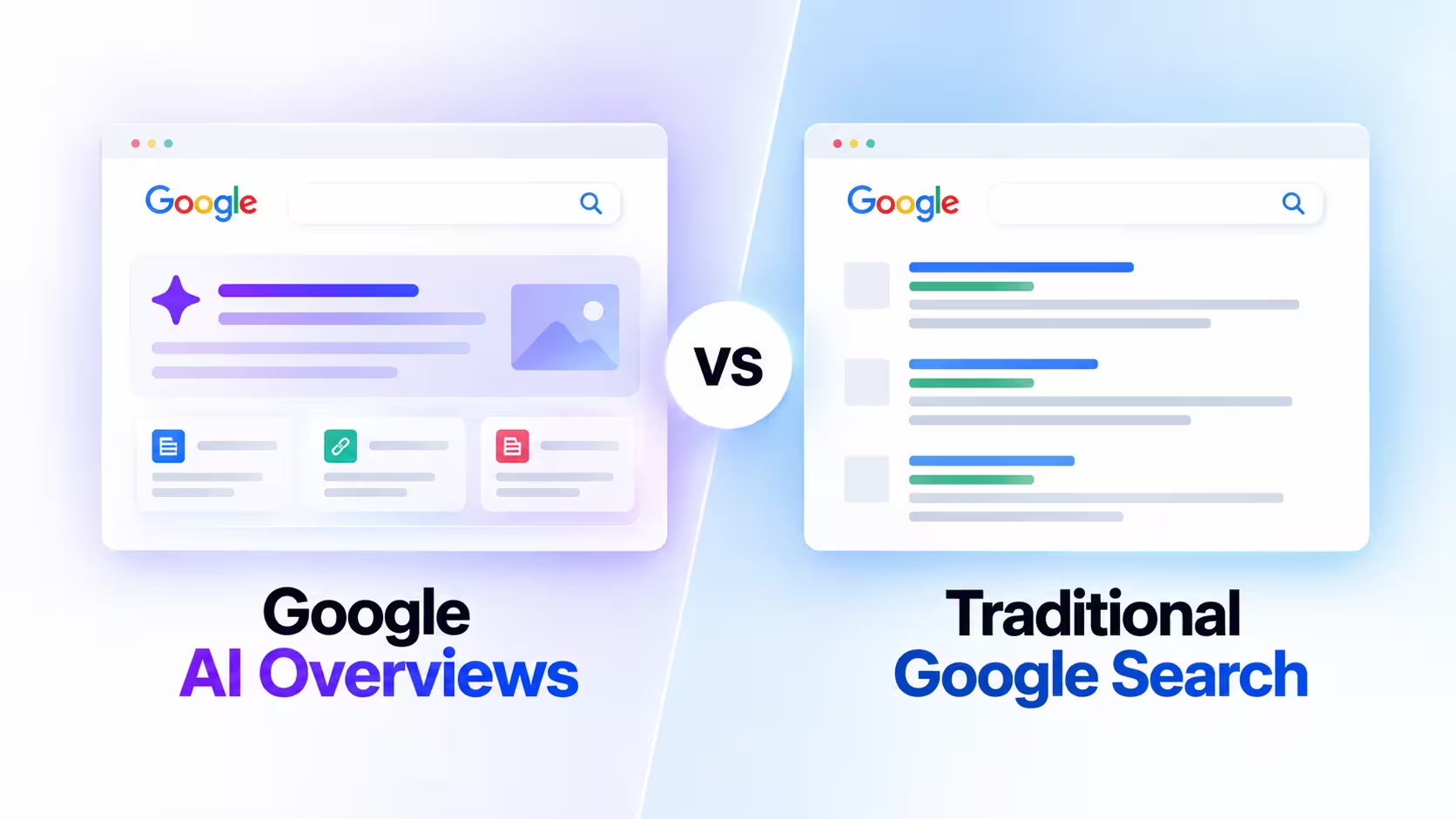
Google Search has changed significantly over the last few years.
For a long time, the basic experience was straightforward: type a query, get a list of webpages, open a few results, and find the answer yourself.
Now, for many searches, Google can place an AI Overview at the top of the results page. Instead of only showing links, Google can generate a summary that combines information from relevant web sources, with links for further exploration.
So, what's actually different?
Is traditional Google Search disappearing? Does AI Overview replace search results? And what does this change mean for website owners and SEO? Let's break it down.
What Is Google AI Overview?
Google AI Overviews are AI-generated summaries that can appear within Google Search results for relevant queries. They are designed to give users a quick starting point for understanding a topic, particularly when a question is more complex than a simple fact lookup.
Google says AI Overviews are integrated with its Search and web-ranking systems rather than simply generating an answer independently from an AI model. They also include links that allow users to explore the underlying web content.
For example, instead of searching "what is retrieval augmented generation" and opening several pages, an AI Overview may provide a short explanation at the top of the results page, followed by links to relevant sources.
What Is Traditional Google Search?
Traditional Google Search primarily works by matching a user's query with relevant webpages and other types of search results. A typical results page can contain:
- Organic search results
- Featured snippets
- Images
- Videos
- Maps
- Shopping results
- News
- Knowledge panels
- Advertisements
- Other specialized Search features
The user generally decides which result to open and reads the information directly from the source. This model is still an important part of Google Search.
AI Overviews don't remove traditional results. Instead, Google is adding an AI-generated layer to the Search experience for queries where it determines that an AI response can be useful.
Google AI Overviews vs Traditional Google Search
Here's the simplest comparison:
| Traditional Google Search | Google AI Overviews |
|---|---|
| Primarily presents search results | Provides an AI-generated summary |
| User visits multiple pages to research | AI can summarize information first |
| Keyword-based queries work well | More conversational questions are supported |
| User connects information between sources | AI can synthesize information from multiple sources |
| Results are mostly separate listings | Summary can appear above or alongside results |
| User decides which pages to read | AI provides a starting point with links |
| Search → click → research | Ask → overview → explore |
The two experiences aren't completely separate. AI Overviews are part of Google Search itself.
How Does a Traditional Google Search Work?
Imagine you search "best AI tools for small businesses." A traditional search experience might give you a collection of webpages — an AI tools directory, a software company's article, a review website, a marketing blog, and a comparison page.
You then open several pages and compare the information.
The search engine helps you find the information, but you generally do the research yourself.
How Does Google AI Overview Work?
Now imagine asking the same question. Google may generate an AI Overview that summarizes relevant information and provides links to websites where you can explore the subject further. The simplified process looks like:
Your query → Google Search systems → Relevant information → AI-generated summary → Supporting links
Google has explained that AI Overviews are connected to its core Search systems and are intended to ground their responses in web results.
This means the AI Overview isn't simply a chatbot answering from its training data.
It's part of a search system that retrieves information from the web.
The Biggest Difference: How You Get Information
The biggest difference is how much work happens before you see an answer.
Traditional Search: You search → Google gives you results → You open pages → You compare information → You form an answer.
AI Overview: You search → Google summarizes relevant information → You review the summary → You explore supporting sources.
This can make some searches much faster.
But it doesn't mean the AI-generated summary should always be treated as the final answer. For important or complicated subjects, checking the original sources is still useful.
AI Overviews Are More Useful for Complex Questions
Traditional keyword searches work extremely well for straightforward queries. For example, "Kuwait currency" — you probably don't need a long AI-generated explanation.
But consider: "What should a small business consider when choosing an AI customer-support tool, and what are the main differences between cloud-based and self-hosted options?"
That's a much more complicated question. Instead of breaking it into several searches, an AI-powered experience can provide an initial overview and let you continue exploring.
Google says its AI Search experiences are designed to help with more complex questions that may previously have required multiple searches.
Search Is Becoming More Conversational
One major change is that users don't always need to start a completely new search for every follow-up question. For example:
- Question 1: What is AI automation?
- Follow-up: How is it different from AI agents?
- Follow-up: Which one is better for repetitive business workflows?
- Follow-up: Give me some examples.
Google has increasingly connected AI Overviews with AI Mode, allowing users to move from an overview into a conversational search experience while maintaining context.
This turns Search into more of an ongoing research conversation.
AI Overviews Can Combine Information
Another important difference is the ability to synthesize information. Suppose you're researching "How does RAG work and when should a business use it?" You may need information about retrieval, AI models, knowledge bases, embeddings, business applications, and limitations.
Traditional Search gives you individual sources. AI Search can attempt to bring relevant information together into a single overview.
Google has also been adding more ways to explore the original websites, including article suggestions, direct links, website previews, and perspectives from online discussions.
Does AI Overview Replace the Search Results?
No. This is an important distinction.
AI Overviews are an additional Search experience, not simply a replacement for the traditional web. Google continues to show links and other Search results alongside its AI features. In 2026, Google has also emphasized making it easier for users to discover original content and websites from AI-generated responses.
The Search experience is becoming more of a combination:
AI-generated information + traditional search results + links + other Search features
What Happens to Website Traffic?
This is one of the biggest concerns for website owners. If Google gives users an answer directly, they may not need to click a website for every simple question. That can potentially change how websites receive traffic from Search.
At the same time, Google says its AI Search features are designed to help users discover websites and original content. Google has introduced more links and source-discovery features within AI Overviews and AI Mode.
Google also reported that links to supporting web pages within AI Overviews can drive traffic to publisher sites.
So the effect isn't simply: AI Overview = no website traffic.
The more realistic picture is that the path from Search to a website is changing.
What Does This Mean for SEO?
SEO still matters. But website owners now have another consideration:
Can Google understand and use my content when generating AI-powered Search experiences?
Google's AI Search documentation and announcements continue to emphasize high-quality content, useful information, original perspectives, and discoverability. For website owners, this means continuing to focus on fundamentals such as:
- Helpful content
- Clear site structure
- Strong technical SEO
- Search intent
- Original information
- Reliable sources
- Good user experience
- Crawlability and indexability
Traditional SEO vs AI Search Visibility
The goals overlap, but there are some differences.
| Traditional SEO | AI Search Visibility |
|---|---|
| Rank for search queries | Be useful for AI-generated answers |
| Target keywords | Cover topics and user intent |
| Earn organic clicks | Earn visibility, citations and clicks |
| Optimize individual pages | Build strong topical coverage |
| Focus heavily on rankings | Consider how content is referenced |
| Search snippets matter | Content context matters more broadly |
This doesn't mean you need to abandon traditional SEO. Instead, AI Search adds another layer to an existing SEO strategy.
Content Quality Matters More Than Just Keywords
Imagine two websites. Website A has an article stuffed with keywords: "AI tools are the best AI tools for businesses. These AI tools can help businesses use AI tools..."
Website B has a detailed article explaining what the tools actually do, who they are suitable for, pricing differences, real examples, limitations, how they compare, and original observations.
The second type of content provides much more useful information for both users and search systems.
Google has continued emphasizing original and high-quality content in its AI Search updates.
AI Overviews and Featured Snippets Are Different
It's easy to confuse the two.
Featured Snippet: Google selects a portion of a webpage and displays it prominently in the search results.
AI Overview: Google generates a summary using AI and can combine information from multiple sources.
Both can appear within Search, but they work differently.
AI Overviews vs AI Mode
These are also different. AI Overviews generally provide an AI-generated summary within the normal Search results experience.
AI Mode provides a more conversational AI Search experience designed for deeper questions, follow-ups, reasoning, and multimodal interactions.
Google has described AI Mode as its more advanced AI Search experience, with capabilities such as query fan-out, deeper research, follow-up questions, and multimodal input.
In 2026, Google has increasingly connected AI Overviews and AI Mode into a more seamless experience.
Search Is Becoming Multimodal
Traditional search was mostly text-based. Modern Google Search increasingly supports different types of inputs. You can search using text, images, voice, files, and other visual inputs.
Google says AI Mode can combine different types of inputs to handle more complex searches.
For example, instead of typing "What type of plant is this?" you can upload an image and ask the question directly.
What Are the Advantages of AI Overviews?
- Faster Answers: You can get a quick summary without immediately opening multiple pages.
- Better for Complex Questions: AI can summarize different parts of a topic into one response.
- Easier Follow-Ups: You can continue exploring the subject conversationally.
- Source Discovery: AI Overviews can provide links to relevant websites for further reading.
- More Natural Queries: You can ask questions in everyday language rather than thinking about exact keywords.
What Are the Limitations?
AI Overviews aren't perfect.
AI Can Get Things Wrong
An AI-generated summary can misunderstand a question or incorrectly interpret information.
Google itself has acknowledged that AI Search can make mistakes, including cases involving misunderstood queries or information on the web.
Summaries Can Remove Context
A short summary may leave out important details, qualifications, or exceptions found in the original source.
That's why source links remain important.
Not Every Query Needs AI
For a simple query such as "YouTube" or "Kuwait weather," you may simply want a direct result.
AI becomes more useful when the question requires explanation, comparison, or research.
What Does This Mean for AI Tool Websites?
For an AI tools directory or AI-focused website, the shift toward AI Search creates an important content opportunity. Instead of publishing only "Best AI Tools," you can create deeper content around questions such as:
- What is generative AI?
- What is AI Search?
- How do AI agents work?
- What is RAG?
- What is multimodal AI?
- Which AI tools are useful for marketers?
- What is the difference between AI automation and AI agents?
This type of content creates broader topical coverage and gives search engines more context about your website.
Combining tool listings, educational articles, comparisons, and practical guides can create a more complete resource for people researching AI.
The Future of Google Search
Google Search is moving toward a more integrated experience where traditional results and AI-powered answers work together.
In 2026, Google has announced continued expansion of AI Mode, AI Overviews, multimodal Search, and even information agents that can monitor topics and provide updates.
This suggests that Search is evolving from "Find me a webpage" toward "Help me understand this, research it, and continue exploring it."
Traditional Search remains an important part of that experience. AI Overviews simply add another layer between the user's question and the information available across the web.
Frequently Asked Questions
What is Google AI Overview?
Google AI Overview is an AI-generated summary that can appear in Google Search for relevant queries, with links that allow users to explore supporting web content.
Is AI Overview replacing Google Search?
No. AI Overviews are integrated into Google Search alongside traditional results and other Search features.
What is the main difference between AI Overview and traditional Search?
Traditional Search primarily presents webpages and other results for users to explore. AI Overviews can summarize information and provide a generated response before users explore the underlying sources.
Does AI Overview use websites?
Yes. Google says AI Overviews are integrated with its Search and ranking systems and include links to relevant web content.
Does AI Overview affect SEO?
It can change how users discover and interact with websites. Website owners therefore need to consider both traditional organic visibility and visibility within AI-powered Search experiences.
Should websites still do SEO?
Yes. Technical SEO, useful content, search intent, crawlability, indexing, and other fundamentals remain important. AI Search adds another way for users to discover content.
Is AI Mode the same as AI Overview?
No. AI Overviews are generated summaries within Search, while AI Mode is Google's more conversational AI Search experience designed for deeper exploration and follow-up questions.
Final Thoughts
Google AI Overviews aren't simply a new version of the traditional search results page. They represent a shift in how Google can help users interact with information.
Traditional Search gives you webpages and lets you investigate them. AI Overviews can give you a starting explanation, connect information, and point you toward sources.
The two experiences are increasingly being combined rather than treated as completely separate systems. For users, that means Search can become more conversational and useful for complicated questions.
For website owners, it means SEO is becoming more than simply trying to rank a page for a keyword. Creating clear, useful, original, trustworthy content is increasingly important because that content may be discovered through traditional results, AI Overviews, AI Mode, or other Search experiences.
The important question for content creators in 2026 is no longer only "How do I rank on Google?"
It's also "How can my content become a useful source when Google generates an answer?"
Want to explore more of what's next in AI?
At Aivellow, we're following these developments closely and helping users discover AI tools across productivity, marketing, coding, content creation, research, automation, and more. Check out our What Are AI Agents guide and our AI Trends to Watch in 2026. See our Best AI SEO Tools guide, our full Top 25 Best AI Tools in 2026 guide, and our ChatGPT vs Claude vs Gemini comparison. Browse our Top AI Productivity Tools and Best AI Marketing Tools guides, explore more by category, submit a tool we should feature, or get in touch if you have questions.