

Consensus
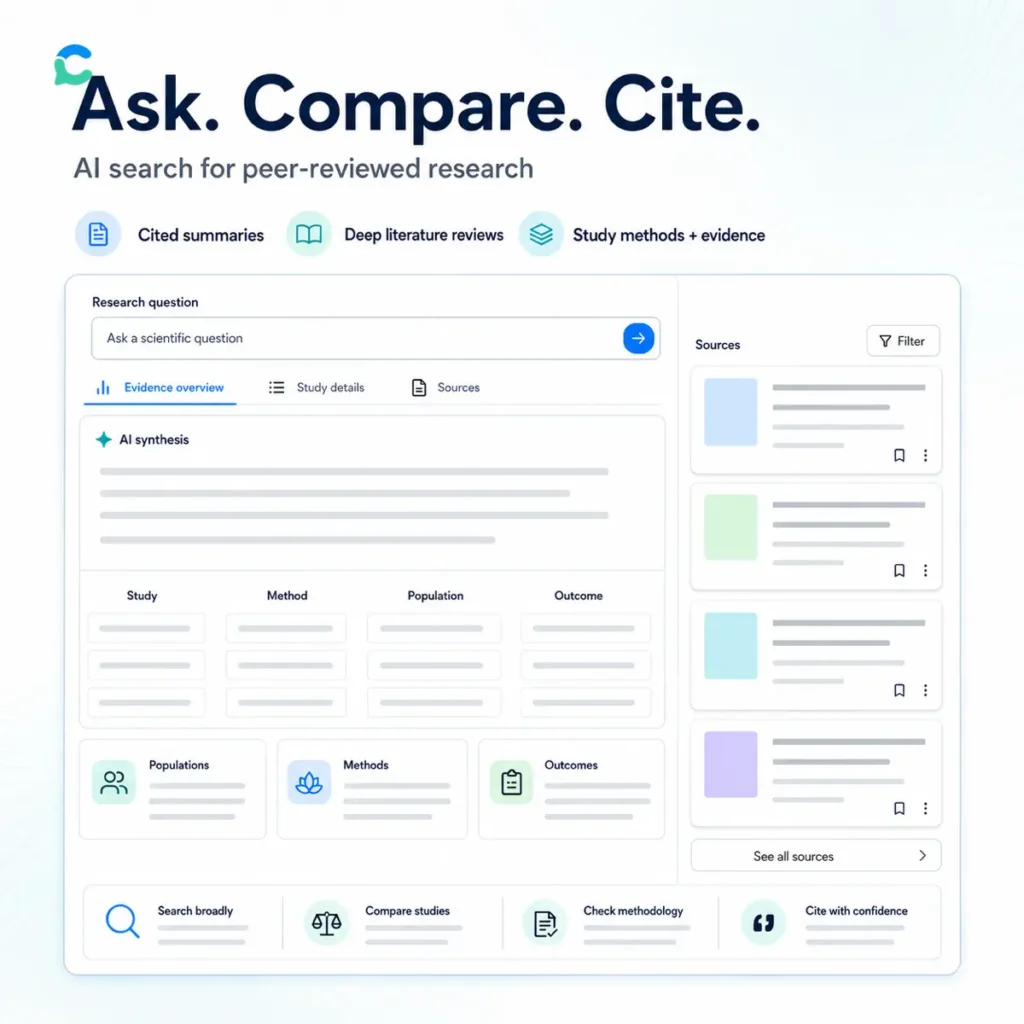
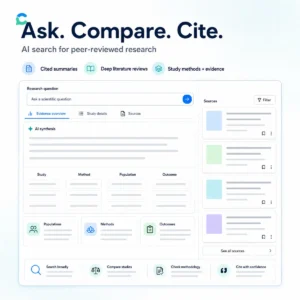
Consensus is an AI academic search engine for finding, comparing, and understanding scientific research. It searches a database of more than 220 million peer reviewed papers, then uses AI to analyze the retrieved material and produce answers with linked citations. Searches combine semantic matching with traditional keyword search. Results are ranked using relevance, publication recency, citation activity, and journal reputation. You can enter a natural language question, keywords, a paper title, an author, Boolean operators, or a DOI. Paper Search returns a conventional list of papers without generating a summary. Pro searches analyze a selected group of relevant papers and produce a cited synthesis. Each citation opens the supporting source, making it easier to check whether the paper supports the generated statement. Deep review handles larger research questions. It divides the question into smaller searches, examines a broad set of potentially relevant papers, and builds a structured literature review from the strongest results. Reports can include methods, findings, counterpoints, evidence tables, research gaps, influential authors, and citation graphs. Consensus explains the Deep review process. The Consensus Meter summarizes whether studies appear to support, reject, or provide mixed answers to a yes or no question. It is useful for seeing disagreement quickly, but it is not a formal meta analysis. Study quality, sample size, methodology, population, and effect size still need to be examined separately. Study Snapshots extract details such as research design, population, sample size, study duration, outcomes, and results. Ask Paper lets you question an individual paper, while full text chat works across saved papers, uploaded documents, and collections. Advanced filters can narrow results by publication year, study design, human or animal population, sample size, study duration, journal rank, publisher, academic field, country, citation count, and open access status. Preprints can also be excluded when you only want published research. Medical Mode searches a curated collection of medical papers and clinical guidelines. It can help clinicians and healthcare researchers locate evidence, but generated summaries should not be used as patient specific medical advice. Check the original study, current clinical guidance, and local standard of care. Consensus for US research and education Consensus is not restricted to the United States. However, its country filter can isolate studies conducted in the USA, which is helpful when location affects healthcare systems, education policy, demographics, regulation, or consumer behavior. American university students can use it to find sources for assignments and literature reviews. Faculty, librarians, healthcare professionals, policy researchers, and evidence based business teams can use it to compare research without relying entirely on a general web search. Users can connect an institutional library to improve access to subscribed full text material. Academic integrity and permitted AI use vary between US universities, departments, and journals, so students and researchers should follow their institution’s current rules. My Library stores papers and collections. You can upload PDFs, import Zotero libraries, or add papers through DOI, RIS, and BibTeX files. Search results and reports can be exported in common citation formats or copied into Word, Google Docs, Notion, Obsidian, and LaTeX workflows. Consensus states that private uploads remain accessible only to the account owner unless a collection is deliberately shared. It also states that queries, uploaded content, and personal information are not used to train its models. Consensus privacy policy AI summaries can still miss qualifications, misread methodology, or give too much weight to papers that happen to rank well. Full text is not available for every publication, which means some analysis may rely on abstracts. A real citation confirms that a paper exists. It does not guarantee that the generated interpretation is correct. Independent feedback is broadly positive about source discovery and cited summaries, while critical users mention shallow treatment of specialist topics and occasional loss of scientific context. G2 reviews reflect both experiences. A free tier provides paper search and limited access to advanced analysis. Paid plans increase Pro, Deep review, and Study Snapshot allowances. Team subscriptions are available for laboratories, departments, and research organizations. Consensus: Pros & Cons Pros (The Wins) Cons (The Friction) Research grounded: Answers begin with real academic papers. Interpretation risk: Summaries can miss context or methodological detail. Linked citations: Statements connect back to supporting sources. Coverage gaps: Full text is not available for every publication. Detailed filters: Control study type, country, population, and quality. Simplified agreement: The Consensus Meter is not a formal meta analysis. Deep reviews: Build structured reports across multiple searches. Usage allowances: Advanced research limits depend on the plan. Key features Natural language academic search Semantic and keyword paper retrieval More than 220 million research papers Cited AI research summaries Deep literature reviews Research Agent for multistep searches Consensus Meter Claims and evidence tables Research gap heat maps Citation graphs and timelines Study methodology snapshots Full text paper chat Medical paper and guideline search Country and population filters Study design and sample size filters Journal rank and publisher filters Saved papers and collections Private document uploads Zotero library imports DOI, RIS, and BibTeX imports PDF and citation exports Institutional library connections ChatGPT and Claude integrations Alternatives to Consensus Perplexity: Searches the wider web and produces cited answers across general topics, while Consensus concentrates on academic papers and scientific evidence. Read more