
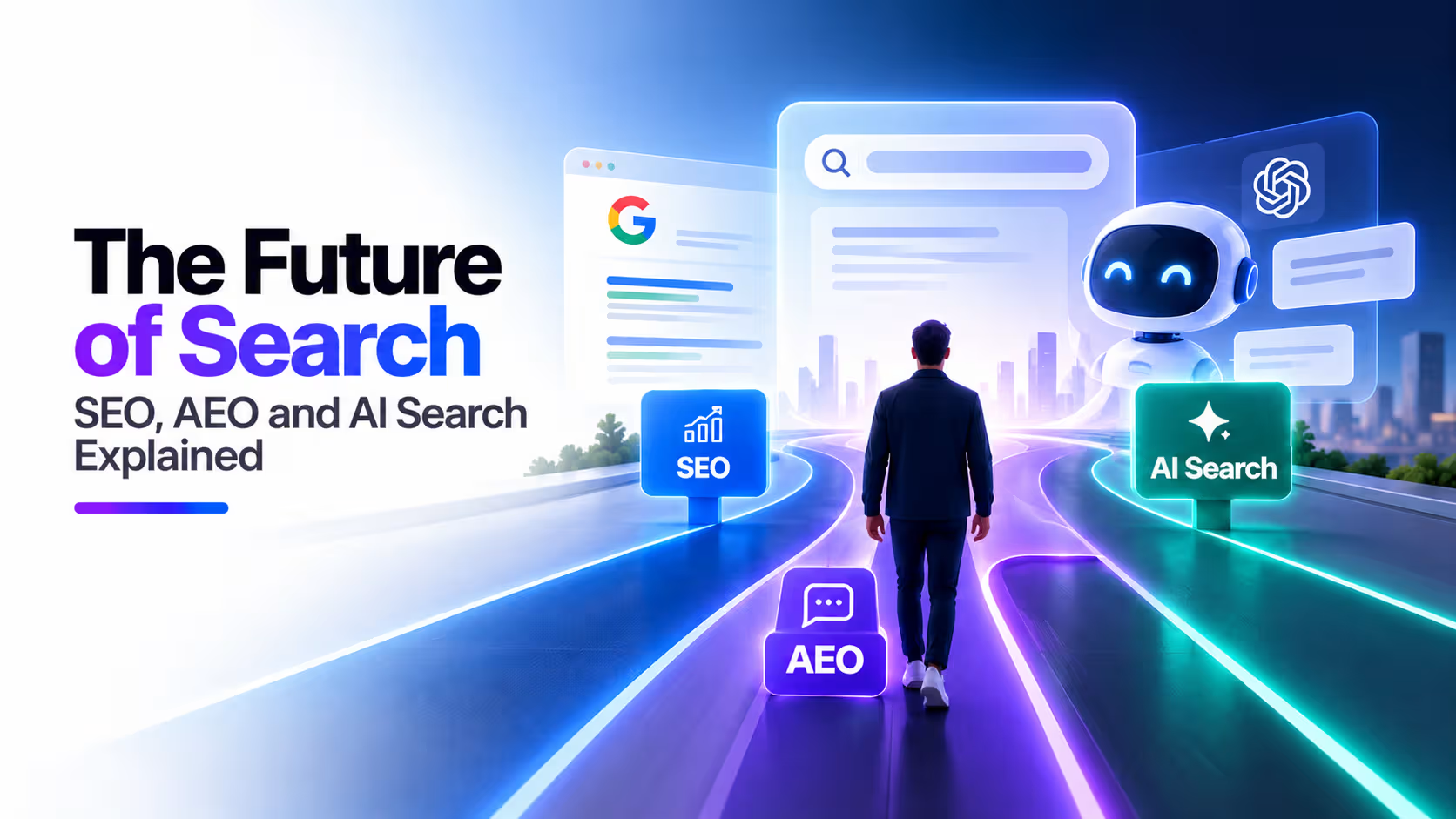
Search is changing faster than ever. People still use Google to find websites, products, and services, but they are also asking AI tools questions, comparing recommendations, and discovering brands through AI-generated answers.
For businesses, marketers, and website owners, this creates a new challenge:
How do you make your content visible when people search on Google, ask an AI assistant, or use an AI-powered search engine?
The answer is not to abandon traditional SEO. It is to understand how SEO, Answer Engine Optimization (AEO), and AI Search Optimization work together.
In this guide, we will explain each approach, compare their differences, and explore practical ways to prepare your website for the future of search.
What Is the Future of Search?
The future of search is moving toward a combination of traditional search results, AI-generated summaries, conversational answers, and personalized discovery experiences.
Instead of relying only on a list of links, users can increasingly ask detailed questions and receive summarized answers supported by information from multiple sources.
Consider someone looking for a website development company. They might:
- Search Google for "best website development company in Kuwait."
- Ask an AI assistant to compare web development agencies.
- Use an AI-powered search engine to research prices and services.
- Visit a company's website to review its portfolio and request a quotation.
Each step represents a potential opportunity for a business to be discovered.
The important point is that search is becoming more diverse. Businesses need to help customers discover their content across these experiences while maintaining a website that converts visitors into customers.
1. What Is SEO (Search Engine Optimization)?
Search Engine Optimization, or SEO, is the process of improving a website so search engines can understand its content and users can find it through relevant search queries.
Traditional SEO focuses on helping your pages appear in organic search results. It includes technical improvements, content optimization, keyword research, website structure, and building credibility.
Key Elements of SEO
- Keyword research: Understand what your target audience searches for.
- On-page SEO: Improve titles, headings, page content, image descriptions, and internal links.
- Technical SEO: Make your website crawlable, indexable, mobile-friendly, and fast.
- Content quality: Publish useful, accurate, original information.
- Authority and reputation: Earn relevant mentions and links from credible websites.
- User experience: Make it easy for visitors to find information and complete actions.
For example, a company offering web development in Kuwait might create a page targeting "website development company in Kuwait." That page should explain its services, experience, process, portfolio, and how customers can get in touch.
SEO helps the right audience discover that page through relevant searches.
Google's official documentation continues to emphasize helpful, reliable, people-first content and established SEO fundamentals.
2. What Is AEO (Answer Engine Optimization)?
Answer Engine Optimization, or AEO, is the practice of making content easy for answer-focused systems to understand, extract, and potentially use when responding to a question.
These systems include AI-powered answer experiences, featured answers, and conversational search tools. Depending on the platform, the result may be a short answer, a summary, a recommendation, or a response with source links.
Traditional SEO often aims to help a page rank in a list of results. AEO places additional emphasis on making the page a useful source for a specific answer.
Key Elements of AEO
- Answer common customer questions directly.
- Use descriptive, question-based headings where appropriate.
- Provide concise definitions before going into detail.
- Organize information into logical sections.
- Support claims with reliable evidence and relevant sources.
- Use structured data where it accurately represents the visible page content.
- Make important facts about your organization, products, and services clear.
Example of AEO in Practice
Imagine a customer asks:
"What should a small business include on its website?"
A useful page might begin with a direct answer:
A small business website should clearly explain its services, introduce the company, provide contact details, establish trust through examples or testimonials, and make it easy for visitors to enquire or purchase.
The page could then explain each element with examples, practical advice, and common mistakes.
This structure helps readers quickly find the answer while giving search and answer systems clearly organized information to interpret.
Important: AEO does not guarantee that an AI tool will select, quote, or cite your content. The goal is to make the information genuinely useful and easy to understand.
3. What Is AI Search Optimization?
AI Search Optimization is the broader practice of improving how a business and its content can be discovered through AI-powered search and answer experiences.
This may involve standalone AI search tools, conversational assistants that retrieve web information, and AI features integrated into traditional search engines.
AI search systems can combine retrieval, relevance assessment, and language generation to produce answers. Their methods differ by product, and there is no single ranking formula that applies to every AI platform.
What Businesses Should Focus On
- Content that answers the full question: Explain the topic clearly, including relevant details, exceptions, and next steps.
- Original information: Provide firsthand experience, real examples, useful data, case studies, and perspectives that add value beyond a generic summary.
- Clear brand and business details: Ensure your website explains who you are, what you do, where you operate, and which customers you serve.
- Reliable supporting information: Use accurate claims and credible sources. Keep important details consistent across your website and other trusted business profiles.
- Technical accessibility: Make sure important pages can be crawled and indexed where appropriate. Avoid accidentally blocking content through robots.txt, access restrictions, or other technical settings.
- Measurement: Monitor traditional organic search performance as well as identifiable AI referrals, brand visibility, enquiries, and sales.
Google's official guidance for AI Overviews and AI Mode says the same foundational SEO practices remain relevant, and that there are no additional technical requirements specifically for these AI features.
4. SEO vs AEO vs AI Search: What's the Difference?
| Feature | SEO | AEO | AI Search Optimization |
|---|---|---|---|
| Main goal | Improve organic search visibility | Make content useful for direct answers | Improve discovery across AI-powered search experiences |
| Typical result | A ranked webpage | A direct answer or source used in an answer | A mention, citation, recommendation, answer link, or visit |
| Content focus | Relevant, useful pages | Clear answers to specific questions | Helpful, well-structured, trustworthy information |
| Technical focus | Crawling, indexing, performance, site structure | Clear content structure and accessible facts | Strong SEO foundations and platform-appropriate accessibility |
| Authority signals | Relevant links, reputation, expertise | Trustworthy evidence and clear sourcing | Consistent, credible information across relevant sources |
| Measurement | Rankings, impressions, clicks, conversions | Answer visibility and citations where measurable | AI referrals, visibility, conversions, and organic performance |
The terminology overlaps in practice. AEO is often treated as one part of a broader AI search strategy rather than a completely separate discipline.
A key distinction is that ranking well, being cited in an AI answer, and generating a qualified business enquiry are three different outcomes. A successful strategy should consider all three.
5. How SEO, AEO, and AI Search Work Together
You do not need three disconnected marketing strategies. The strongest approach is to build one useful website and adapt its content to different discovery experiences.
SEO Foundation
Make pages accessible, indexable, relevant, and useful. Organize your site so people and search engines can understand it.
AEO Content Structure
Answer specific questions directly, use clear headings, define key terms, and support important claims with evidence.
AI Search Readiness
Build original expertise, maintain accurate business information, earn relevant mentions, and monitor visibility across platforms.
Business Outcomes
Evaluate qualified traffic, brand discovery, enquiries, purchases, and customer trust—not just rankings or mentions.
A Practical Example
Suppose an ecommerce business sells ergonomic office chairs.
- SEO: Create an optimized category page for ergonomic office chairs, with clear product details and useful navigation.
- AEO: Publish a guide answering "How do I choose an ergonomic office chair for long working hours?"
- AI Search Optimization: Include original product comparisons, accurate specifications, real customer feedback, and clear buying guidance.
- Measurement: Track organic clicks, product-page visits, sales, and identifiable AI referral traffic.
One well-maintained set of pages can support all three approaches.
6. How to Optimize Your Website for the Future of Search
Step 1: Start With Your Audience's Real Questions
Create a list of questions customers ask before contacting your business or purchasing a product. Examples include:
- How much does the service cost?
- Which solution is right for my business?
- What is the difference between two products?
- How long does implementation take?
- What are the benefits and limitations?
- What should I check before making a decision?
Use these questions to guide service pages, product content, tutorials, comparison articles, and FAQs.
Step 2: Lead With a Clear Answer
When a page addresses a specific question, answer it early. Then provide the supporting explanation, examples, qualifications, and next steps. This helps readers understand the main point without having to search through a long introduction.
Avoid forcing keywords into every heading. Natural language and clear explanations are more important than repetitive phrasing.
Step 3: Build Topic Clusters
Instead of publishing unrelated articles, develop a connected collection of content around your main subject. For example, a digital marketing website might publish:
- What Is SEO?
- What Is Answer Engine Optimization?
- SEO vs AEO: What's the Difference?
- How AI Search Engines Find Information
- How to Make Content More Visible in AI Search
- How to Track AI Search Traffic
Link related articles naturally so readers can move from basic explanations to more detailed guides.
Step 4: Publish Original, Useful Information
AI can generate generic explanations quickly, so businesses should look for ways to add information that readers cannot get from a shallow summary. Include real project experience, original examples, clear methodology, expert commentary, and relevant data where available.
Do not publish large volumes of near-identical articles simply to target more keywords. Google's guidance recommends creating content primarily to help people, not to manipulate search rankings.
Step 5: Improve Technical SEO
Review these foundations regularly:
- Important pages return the correct status codes and can be indexed.
- XML sitemaps include the appropriate canonical URLs.
- Internal links help users discover related content.
- Mobile pages work properly and load efficiently.
- Page titles and meta descriptions accurately describe each page.
- Structured data reflects the content visible to users.
- Images have useful alternative text when they convey information.
- Business details, product information, and contact details are accurate.
You do not need to add unverified special tags or create a separate AI-only file just to qualify for Google's AI search features. Follow official platform guidance instead.
Step 6: Build Trust Beyond Your Own Website
Your own pages are important, but people also evaluate businesses through other sources. Maintain accurate profiles, collect genuine reviews, contribute useful expertise to relevant publications, and build relationships that lead to legitimate industry mentions.
Avoid buying fake reviews or manufacturing mentions solely to influence AI answers.
Step 7: Measure Visibility and Conversions
Set up a simple monthly report that includes:
- Organic search impressions and clicks.
- Important page rankings and landing-page performance.
- AI referrals where analytics can identify them.
- Leads, purchases, and other conversion events.
- Changes in conversion rate and lead quality.
- Brand mentions and source citations where they can be checked reliably.
AI visibility is not always measurable with the same precision as website traffic. Treat manual AI answer checks as directional observations, not as a complete measure of performance.
7. Common Mistakes to Avoid
As businesses adapt to AI search, avoid these common mistakes.
1. Treating AEO as a Replacement for SEO
A page that cannot be discovered or accessed may struggle to contribute to search visibility. Start with solid SEO fundamentals.
2. Publishing Content Just to Satisfy AI Tools
Content should solve a real problem for your audience. Rewriting existing articles without adding meaningful value is unlikely to create a strong competitive advantage.
3. Assuming Structured Data Guarantees AI Citations
Structured data can help search engines interpret page information when used correctly, but it does not guarantee rankings, inclusion in AI answers, or citations.
4. Focusing Only on Keywords
Keywords matter, but a page also needs to satisfy the intent behind the search. Explain the subject fully enough to help readers make an informed decision.
5. Ignoring Conversions
A brand mention may create awareness without producing a visit or sale. Measure business outcomes alongside visibility.
6. Expecting Immediate Results
SEO and AI search visibility can take time to develop. Publish useful information consistently, maintain your technical foundations, and review performance before making major strategy changes.
8. What Does the Future of Search Look Like?
Several developments are likely to influence how businesses approach search over the coming years.
More Conversational Searches
People can ask longer, more detailed questions and follow up when an answer does not meet their needs. Businesses should create content that addresses the complete problem, not just a short keyword phrase.
More AI-Generated Summaries
Search experiences may increasingly summarize information from multiple sources. Clear explanations, original evidence, and useful supporting details can make a page more valuable to readers and potentially useful as a source.
More Diverse Discovery Channels
Customers may discover a company through conventional search results, AI answers, video, social platforms, reviews, or industry publications. A resilient strategy should not depend entirely on one source of traffic.
Greater Importance of Original Expertise
When generic information becomes easier to produce, firsthand experience, useful research, detailed examples, and credible evidence can help a business stand out.
More Emphasis on Business Outcomes
Marketers will need to look beyond rankings and raw traffic. Understanding whether search visibility leads to qualified enquiries, purchases, and returning customers will remain essential.
These are strategic expectations, not guarantees about how every platform will evolve. Search products and their measurement capabilities will continue to change.
9. Future of Search: A Practical Checklist
Use this checklist to review your website's readiness.
| ✓ | Website Readiness |
|---|---|
| ☐ | Important pages are accessible and indexable |
| ☐ | Titles, headings, and internal links are clear |
| ☐ | Service and product information is accurate |
| ☐ | Content answers real customer questions |
| ☐ | Articles include original examples or useful evidence |
| ☐ | Claims are supported by reliable sources where appropriate |
| ☐ | Structured data matches visible page content |
| ☐ | Business details and profiles are consistent |
| ☐ | Analytics tracks enquiries, purchases, and key actions |
| ☐ | Organic search and identifiable AI referrals are reviewed monthly |
Frequently Asked Questions
Is SEO still important in the age of AI search?
Yes. SEO helps search engines discover, understand, and evaluate your website. Google confirms that established SEO practices remain relevant to its AI search features.
What is the difference between SEO and AEO?
SEO focuses on improving a website's visibility in search results. AEO focuses on making content useful and easy to extract for direct answers. Both can support the same page and overall content strategy.
Is AI Search Optimization the same as AEO?
The terms overlap, but AI Search Optimization is often used more broadly to cover discoverability across AI-powered search experiences. AEO generally emphasizes answering questions and being selected as a source for an answer.
Does AEO replace traditional SEO?
No. AEO works alongside SEO. Businesses still need technically accessible pages, useful content, clear site structure, and a good experience for visitors.
Does FAQ schema improve AI search visibility?
FAQ schema should only be used when appropriate and in accordance with current search-engine guidelines. Adding it does not guarantee enhanced results or AI citations. Clear, helpful FAQ content can still benefit readers without special markup.
How long does it take to improve AI search visibility?
There is no universal timeline. Results depend on the website's current condition, competition, content quality, indexing, and the systems being measured. Track progress over time instead of relying on a promised number of days.
Which should a business focus on first: SEO, AEO, or AI Search?
Start with SEO fundamentals and a clear understanding of your customers. Improve your most important pages, answer common questions, add original expertise, and then measure how your business appears across relevant AI search experiences.
Final Thoughts
The future of search is not simply about choosing between Google and AI. It is about understanding how people discover information across different platforms and making sure your business remains useful, credible, and easy to find.
SEO provides the foundation. AEO helps organize information around direct answers. AI Search Optimization broadens the strategy to cover emerging ways people research, compare, and discover businesses.
The most practical approach is to bring these methods together rather than treat them as competing disciplines.
Create content for people first, maintain strong technical SEO, demonstrate real expertise, and measure the results that matter to your business.
That gives your website a stronger foundation for both today's search engines and tomorrow's discovery experiences.
Want to explore more of what's next in AI?
At Aivellow, we're following these developments closely and helping users discover AI tools across productivity, marketing, coding, content creation, research, automation, and more. Check out our What Is GEO guide, our What Is AI Search guide, our How AI Search Engines Rank Information guide, and our How to Make Your Content More Visible in AI Search guide. See our Best AI SEO Tools guide, our full Top 25 Best AI Tools in 2026 guide, and our ChatGPT vs Claude vs Gemini comparison. Explore more by category, submit a tool we should feature, or get in touch if you have questions.