
AI models can answer questions, write content, analyze information, and generate code. But there is one major challenge: an AI model doesn't automatically know everything in your private or constantly changing data.
That's where Retrieval-Augmented Generation (RAG) comes in.
RAG allows an AI system to retrieve relevant information from external sources and use that information to generate a response.
Instead of relying only on what the AI learned during training, a RAG system can search a connected knowledge base, retrieve relevant information, and then use it to answer the user's question.
What Is Retrieval-Augmented Generation?
Retrieval-Augmented Generation (RAG) is an AI architecture that combines two main processes:
- Retrieval — finding relevant information from an external knowledge source.
- Generation — using an AI language model to generate an answer based on that information.
A simple way to think about RAG is:
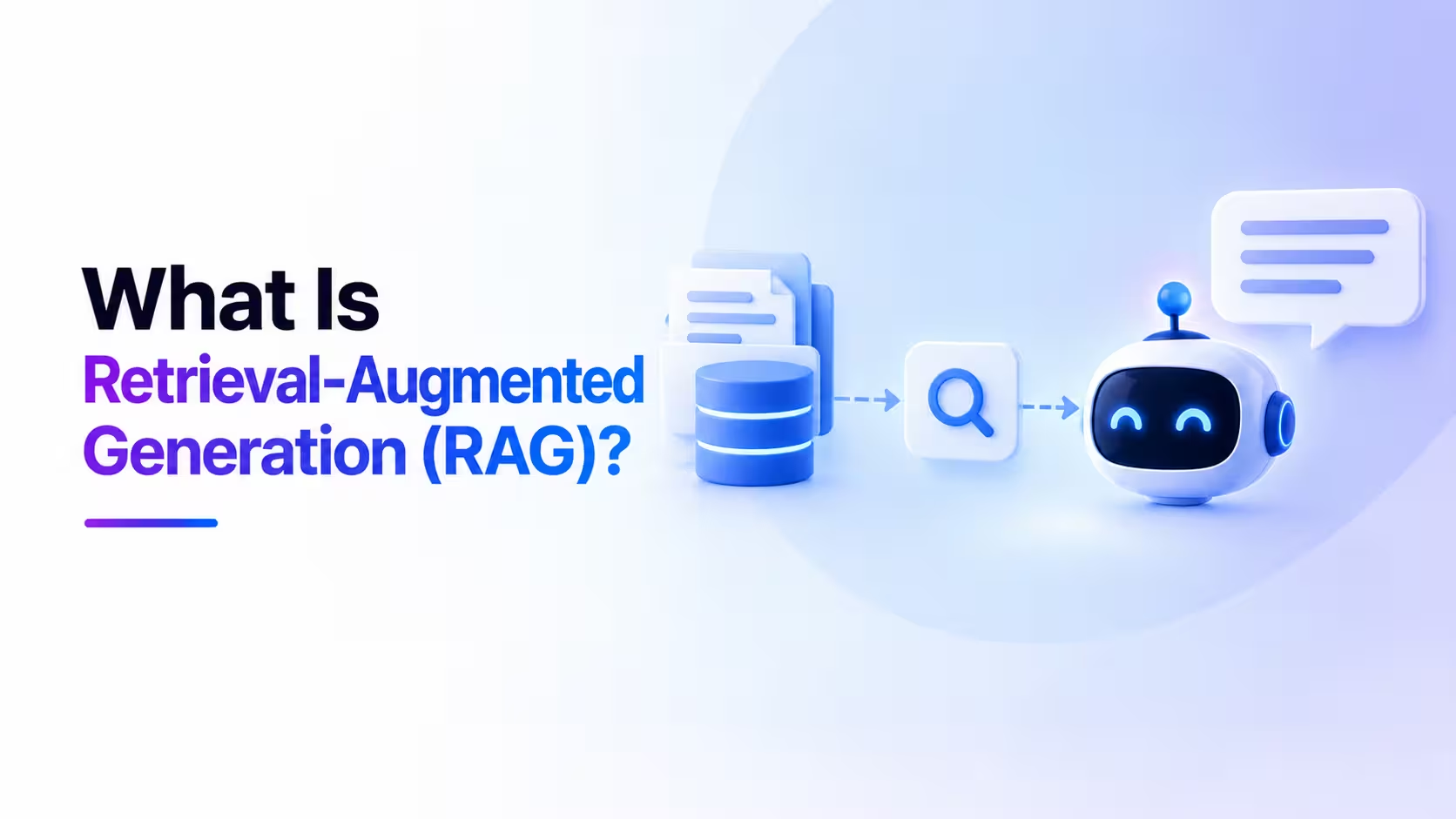
User Question → Search Knowledge → Retrieve Relevant Information → AI Generates Answer
For example, imagine a company has thousands of internal documents. An employee asks:
"What is our refund policy for international customers?"
Instead of expecting the AI model to already know the company's policy, a RAG system can search the company's internal documents, find the relevant policy, and provide the information to the AI model.
The model can then generate a natural-language response.
Why Is RAG Needed?
Large language models are trained on huge amounts of information, but that doesn't mean they automatically have access to every piece of information a user needs. There are several common problems:
Private Information
A general AI model may not know your company's internal policies, product documentation, customer records, employee handbook, technical documentation, or business processes.
Changing Information
Some information changes frequently — product prices, company policies, inventory, regulations, documentation, news, and financial information.
RAG can allow an AI system to retrieve more current information from a connected source.
Specialized Knowledge
A business might have thousands of pages of highly specific information that wasn't part of the model's training data. RAG can connect the model to that knowledge.
How Does RAG Work?
A typical RAG system has several steps.
1. Collect the Information
First, information is gathered from sources such as PDFs, websites, Word documents, databases, product catalogs, knowledge bases, and internal company documents.
This information becomes part of the system's knowledge source.
2. Split the Information Into Smaller Pieces
Large documents are usually divided into smaller sections called chunks. For example, a 100-page document might be divided into hundreds of smaller sections.
This makes it easier for the system to find the specific information relevant to a question.
3. Create Embeddings
The chunks can be converted into numerical representations called embeddings. Embeddings capture the semantic meaning of the text. This allows a system to find information that is conceptually related to a question, even when the exact words are different.
For example, someone asks: "How can I get my money back?"
A semantic search system might find: "Customers may request a refund within 30 days of purchase." Even though the words aren't identical, the meaning is related.
4. Store the Information
The embeddings are typically stored in a vector database or another retrieval system. Common technologies used in RAG systems include Pinecone, Weaviate, Qdrant, Milvus, pgvector, and Elasticsearch.
The choice depends on the application's requirements.
5. User Asks a Question
The user sends a question to the AI application. For example: "What is the warranty period for Product X?"
6. Retrieve Relevant Information
The system searches the knowledge base for information related to the question. It might find several relevant document sections: Product X warranty policy, warranty exclusions, and warranty registration instructions.
7. Add the Retrieved Information to the AI Prompt
The relevant information is provided to the language model as context. The model can then use that context when generating its response.
8. Generate the Answer
Finally, the AI model generates a response based on: User Question + Retrieved Context.
The result can be a natural-language answer instead of simply returning search results.
RAG Example
Imagine you're building an AI assistant for an ecommerce company. Your knowledge base contains:
"Customers can return unused products within 14 days of delivery. Electronics must include all original accessories."
A customer asks: "Can I return my headphones after 10 days?"
The RAG system retrieves the relevant return policy. The AI could respond:
"Yes. If the headphones are unused and include their original accessories, they can generally be returned within 14 days of delivery."
The answer is based on the company's stored information rather than relying entirely on the model's general knowledge.
RAG Architecture
A basic RAG system can be visualized like this:
Documents → Chunking → Embeddings → Vector Database → User Question → Retrieval → Relevant Context → Language Model → Final Answer
RAG vs Traditional AI
| Traditional AI | RAG |
|---|---|
| Relies mainly on model knowledge | Retrieves external information |
| Knowledge may become outdated | Can use updated sources |
| Doesn't automatically know private documents | Can connect to private knowledge |
| Limited to available context | Can retrieve relevant information |
| Can hallucinate information | Retrieved context can help ground responses |
| Updating knowledge may require other approaches | Knowledge sources can often be updated independently |
RAG doesn't completely eliminate hallucinations, but providing relevant source material can help reduce unsupported answers.
Where Is RAG Used?
RAG has many practical applications.
Customer Support
A support chatbot can retrieve information from product documentation, FAQs, support articles, policies, and troubleshooting guides.
This allows the AI to answer questions using the company's own information.
Enterprise Knowledge
Companies can create internal AI assistants that search HR documents, company policies, project documentation, meeting notes, and internal procedures.
Employees can ask questions without manually searching through hundreds of documents.
Ecommerce
RAG can retrieve product information such as specifications, availability, features, compatibility, warranty information, and shipping policies.
Healthcare Research
RAG systems can retrieve relevant information from approved medical literature, research papers, or organizational documentation.
For high-stakes healthcare applications, retrieval quality, source validation, privacy, and professional oversight remain important.
Legal Research
Legal AI applications can use retrieval systems to find relevant documents, contracts, regulations, and case materials.
The retrieved information should still be reviewed carefully because legal information can be complex and jurisdiction-specific.
Developer Documentation
Developers can build AI assistants that search API documentation, code repositories, technical guides, SDK documentation, and internal engineering documentation.
A developer could ask: "How do I authenticate with this API?"
The system can retrieve the relevant documentation before generating the answer.
What Are the Benefits of RAG?
- Access to Private Knowledge: RAG allows AI applications to work with company-specific information.
- Easier Knowledge Updates: Instead of changing the model every time a document changes, the external knowledge source can be updated.
- Better Grounding: Retrieved information gives the model additional context to use when generating its answer.
- More Relevant Responses: The system can retrieve information specifically related to the user's question.
- Source-Based Applications: RAG systems can be designed to show the documents or sources used to answer a question.
- Useful for Specialized Applications: Businesses can build AI assistants around their own documentation and workflows.
Limitations of RAG
RAG isn't a perfect solution.
Poor Retrieval
If the system retrieves the wrong information, the AI may still produce a poor answer.
Bad retrieval → bad context → bad answer. This is one of the biggest challenges when building RAG applications.
Incomplete Documents
If the required information isn't in the knowledge base, retrieval won't magically create it.
Chunking Problems
If documents are divided poorly, important context can be separated across different chunks.
Large Knowledge Bases
Searching millions of documents efficiently can require careful architecture, indexing, ranking, and infrastructure.
AI Hallucinations Can Still Happen
RAG can reduce the chance of unsupported answers, but it doesn't guarantee accuracy.
The language model can still misunderstand or incorrectly interpret retrieved information.
RAG vs Fine-Tuning
RAG and fine-tuning are often confused.
| RAG | Fine-Tuning |
|---|---|
| Gives the model external information at runtime | Changes model behavior through additional training |
| Good for changing information | Good for adapting behavior/style/task performance |
| Can work with private knowledge | Doesn't automatically provide a searchable knowledge base |
| Knowledge can be updated externally | Updating requires another training process |
| Useful for document-based Q&A | Useful for specialized behavior |
In many applications, RAG and fine-tuning can also be used together.
RAG vs AI Agents
RAG and AI agents solve different problems.
RAG: Helps an AI system find relevant information.
AI Agent: Helps an AI system plan and perform actions.
An AI agent can use RAG as one of its tools. For example:
Agent: "Check our refund policy, determine whether this customer qualifies, and create a support response."
The agent could use RAG to retrieve the refund policy before deciding what information to include in the response.
What Is a RAG Pipeline?
A typical RAG pipeline can be divided into two major stages.
Indexing Stage: Documents → Chunking → Embeddings → Vector Database. This happens before users start asking questions.
Query Stage: Question → Retrieval → Context → Language Model → Answer. This happens when a user asks something.
Keeping these two stages separate makes it easier to update and maintain the knowledge base.
The Future of RAG
RAG is becoming an important part of modern AI applications because businesses increasingly want AI systems that can work with their own information.
Future RAG systems are likely to become more sophisticated through improvements in better retrieval, hybrid search, reranking, multimodal retrieval, structured data retrieval, agentic workflows, long-context models, and better source attribution.
RAG is also increasingly being combined with AI agents and multimodal AI, allowing systems to retrieve information from documents, images, databases, websites, and other sources before taking action.
Frequently Asked Questions
What does RAG stand for in AI?
RAG stands for Retrieval-Augmented Generation.
What is RAG in simple words?
RAG allows an AI model to search for relevant information before generating an answer.
Is RAG the same as fine-tuning?
No. RAG provides external information at runtime, while fine-tuning changes how a model behaves through additional training.
Does RAG prevent hallucinations?
No. RAG can help ground an AI response in retrieved information, but it doesn't guarantee that the final answer will be correct.
What database is used for RAG?
RAG systems commonly use vector databases such as Pinecone, Weaviate, Qdrant, Milvus, or PostgreSQL with pgvector. The best choice depends on the application.
Can RAG use PDFs?
Yes. PDFs are one of the common sources used in RAG systems. Their content can be extracted, divided into chunks, embedded, and indexed for retrieval.
Can RAG work with private company data?
Yes. RAG can be designed to retrieve information from private company documents, databases, knowledge bases, and other controlled sources.
Final Thoughts
Retrieval-Augmented Generation makes AI more useful by connecting language models to external knowledge.
Instead of relying entirely on what a model learned during training, a RAG application can retrieve relevant information from a knowledge base and use that information to generate a response.
For businesses building AI chatbots, internal assistants, customer-support systems, document search tools, and AI agents, RAG provides a practical way to connect AI with real-world, specialized, and frequently updated information.
Want to explore more of what's next in AI?
At Aivellow, we're following these developments closely and helping users discover AI tools across productivity, marketing, coding, content creation, research, automation, and more. Check out our What Are AI Agents guide and our AI Trends to Watch in 2026. See our full Top 25 Best AI Tools in 2026 guide and our ChatGPT vs Claude vs Gemini comparison, browse our Top AI Productivity Tools and 15 Best AI Coding Assistants guides, explore more by category, submit a tool we should feature, or get in touch if you have questions.