
AI used to be mostly about text.
You typed a question, and the AI gave you a written answer.
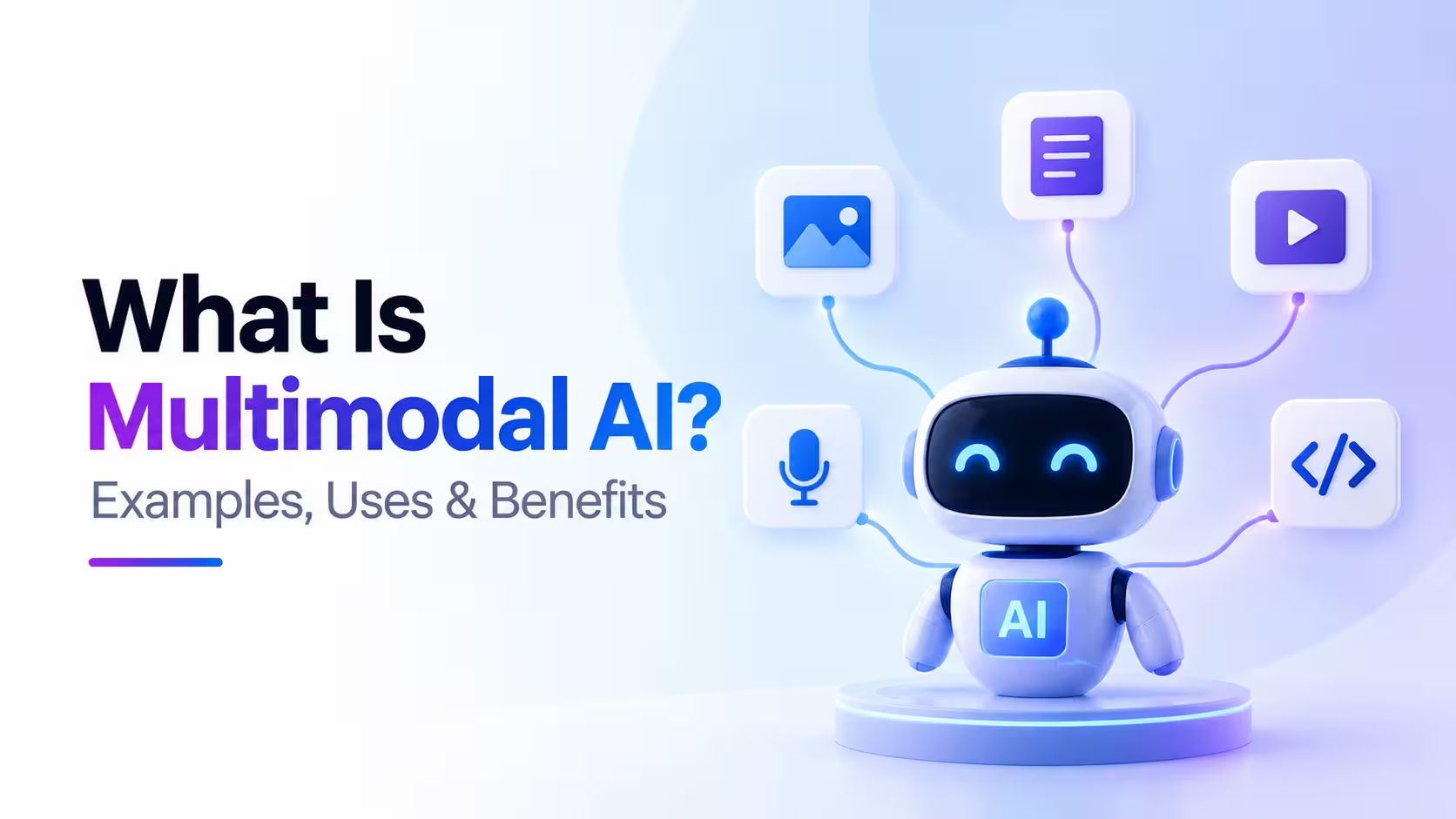
Today, AI can do much more. Modern AI systems can understand combinations of text, images, audio, video, documents, and code and use information from those different formats together.
This is known as multimodal AI.
For example, you could upload a product photo and ask AI to describe it, provide a voice recording and ask for a transcript, or share a chart and ask the AI to explain what the numbers mean.
The interesting part isn't simply that AI can handle different types of information.
It's that it can connect them. You can give an AI a photo, some written instructions, and a video and ask it to reason about all of them together. Modern multimodal models are increasingly designed around this kind of cross-format understanding.
In this guide, we'll explain what multimodal AI is, how it works, real-world examples, common uses, benefits, limitations, and why it matters in 2026.
What Is Multimodal AI?
Multimodal AI is artificial intelligence that can understand, process, or generate information across multiple types of data, or "modalities." These modalities can include:
- Text
- Images
- Audio
- Video
- Speech
- Documents
- Code
- Structured data
A traditional AI system might focus primarily on one type of information. A multimodal AI system can work across several.
For example, instead of only asking "What does this image show?" you could ask:
"Look at this product image, compare it with the specifications in this PDF, and explain which features would be most useful for a small business."
That's a multimodal task because the AI needs to work with both visual and textual information.
What Does "Multimodal" Mean?
The word itself is quite simple. Multi = more than one. Modal = a type or form of information.
So: multimodal AI = AI that works with multiple types of information. You can think of each modality as a different way of communicating.
- Text: Articles, emails, messages, documents, instructions, and code.
- Images: Photos, screenshots, diagrams, charts, product images, and scanned documents.
- Audio: Voice recordings, conversations, podcasts, interviews, and sounds.
- Video: Movies, meetings, tutorials, demonstrations, and recordings.
- Data: Spreadsheets, tables, databases, and structured information.
Multimodal AI brings these formats together so they can be analyzed in the same workflow.
How Does Multimodal AI Work?
The technology behind multimodal AI is complex, but the basic idea is easier to understand.
Imagine you give an AI three things: a photo + a voice recording + a written question. The system needs to:
- Understand the image.
- Understand the audio.
- Understand the text.
- Connect the information.
- Reason about all of it together.
- Produce a useful response.
Modern AI systems use models trained to understand relationships between different types of information. For example, an AI may learn that the word "car," a photo of a car, spoken audio describing a car, and a video showing a car are all related concepts. This allows the model to connect different forms of input.
Modern systems are increasingly capable of reasoning across text, images, audio, video, and other formats. Google, for example, describes Gemini as having multimodal understanding across text, images, video, audio, and code.
OpenAI also identifies multimodal systems as a major area of its AI research, including vision-language understanding, image generation, and audio capabilities.
Multimodal AI vs Traditional AI
The difference becomes clearer with an example.
Traditional Text AI
You provide: "Here is a description of my product." The AI analyzes the text and responds.
Multimodal AI
You provide a product photo, product description, specification sheet, and customer review recording. Then ask: "What are the three strongest selling points of this product?"
The AI can potentially combine all four sources.
That's the real value of multimodal AI. It doesn't just understand more formats.
It can connect information that exists in different formats.
Examples of Multimodal AI
Multimodal AI isn't just a research concept. It's already appearing in consumer and business products.
1. ChatGPT
Modern versions of ChatGPT can work with multiple types of information, including text, images, documents, data, and voice depending on the product and available features. OpenAI documents image input, file analysis, data analysis, and voice capabilities as part of ChatGPT's available tools.
For example, you can provide an image and ask "What's wrong with this design?" Or upload a spreadsheet and ask "What are the biggest changes in sales?"
The AI isn't limited to plain text conversations.
2. Google Gemini
Google has built Gemini around multimodal understanding. Gemini can work across formats such as text, images, audio, video, and code. Google has demonstrated use cases ranging from analyzing presentations and videos to creating interactive learning experiences.
This makes it particularly useful for people already working across Google's ecosystem.
3. AI Image Understanding
You can give a multimodal AI a photograph and ask questions about what it sees. For example: "Describe this room." Or: "What objects are visible in this image?" Or: "Read the information from this screenshot and explain the error."
This is useful in areas ranging from customer support to education and software development.
4. AI Voice Conversations
Voice is another important part of multimodal AI. Instead of typing everything, you can speak naturally to an AI system.
Modern voice systems are moving toward real-time conversations where AI can listen and respond naturally. OpenAI describes current research and products around speech recognition, real-time speech generation, and systems capable of listening and responding during conversations.
5. Video Understanding
Video contains much more information than a single image. It includes visual information, movement, speech, sounds, text, timing, and context. Multimodal AI can potentially analyze these different signals together.
For example, a business could upload a recorded customer interview and ask: "Summarize the customer's main complaints and identify the product features they mentioned."
That's much more useful than simply generating a transcript.
Common Uses of Multimodal AI
The potential applications are enormous. Here are some of the most practical ones.
1. Education
Multimodal AI can make learning more interactive. A student could upload a textbook page, a diagram, a handwritten equation, and a lecture recording, then ask the AI to explain the topic in simple language.
Instead of only reading text, students can learn through a combination of visual and spoken explanations.
Example: A student uploads a physics diagram and asks: "Explain what's happening here like I'm a beginner." The AI can analyze the diagram and explain the concept.
2. Healthcare
Multimodal AI has potential applications in healthcare because medical information often exists in many forms — medical records, images, lab results, doctor notes, patient conversations, and reports.
A multimodal system could potentially help organize and summarize information for qualified professionals.
However, healthcare is a high-stakes area. AI-generated analysis should not be treated as a replacement for qualified medical judgment.
3. Marketing
Marketing teams work with many different types of content — images, videos, copy, customer reviews, analytics, voice recordings, and product information. Multimodal AI can help bring those pieces together.
For example: "Analyze these five customer reviews and product images and suggest three new advertising concepts."
That's a much richer task than simply asking AI to write an advertisement.
4. Customer Support
Customer support often involves screenshots, text messages, documents, and voice recordings. Imagine a customer says "My website isn't working" and uploads a screenshot.
Instead of asking them to describe everything manually, a multimodal AI can potentially analyze the screenshot and identify what might be wrong.
This can reduce back-and-forth communication.
5. E-commerce
Online stores can use multimodal AI to understand products and customer requests. A customer might upload a photo and ask "Can you find something similar?" or "Which of these products would be better for a small apartment?"
AI can combine visual information with product descriptions and specifications.
6. Content Creation
Creators can use multimodal AI across almost every stage of production. For example: video → transcript → summary → social posts → thumbnail idea → blog article.
Instead of manually converting one piece of content into different formats, AI can help repurpose it.
OpenAI describes content creation workflows where AI can work with documents, images, conversations, and other context to generate or adapt content for different audiences and channels.
7. Software Development
Multimodal AI is also useful for developers. A developer can provide a screenshot, error message, code, and documentation, and ask: "Why does this interface look different from the design?"
The AI can potentially connect the visual result with the underlying code.
This is particularly useful for frontend development and debugging.
8. Business Research
Research isn't always text-based. A company might need to analyze reports, charts, presentations, competitor websites, videos, customer interviews, and spreadsheets.
Multimodal AI can potentially analyze these different sources together.
That makes it useful for market research and decision support. AI is already being used for research workflows involving web sources, documents, competitive data, and other forms of information.
9. Accessibility
Multimodal AI can make digital information easier to access. For example, an AI system could describe images, read documents aloud, convert speech into text, explain charts, translate spoken language, and answer questions about visual content.
This can help people interact with information in ways that match their needs.
10. Robotics
Multimodal AI becomes even more interesting when combined with robotics. A robot needs to understand more than text — it needs to interpret visual surroundings, spoken instructions, physical objects, movement, and environmental sounds.
A future robot could potentially receive a spoken instruction, understand what it sees, and determine how to complete the task.
This connects multimodal AI with the broader development of physical AI and robotics.
Benefits of Multimodal AI
Why does all of this matter? There are several major advantages.
1. Better Understanding
People naturally communicate using multiple formats. We don't only use words. We point at things. We show photos. We speak. We draw diagrams. We share documents.
Multimodal AI allows software to work with information in a more human-like way.
2. Less Manual Work
Without multimodal AI, you may need to convert everything into text before an AI system can process it — for example, video → transcript → summary.
With a capable multimodal system, the video itself can potentially become part of the analysis. That can remove unnecessary steps.
3. More Natural Interactions
Talking to an AI using voice and visual information can feel more natural than typing every instruction. You can show something instead of describing it. That's a significant usability improvement.
4. Better Context
A single source rarely contains the entire story. A customer review might explain what happened. A product image shows what the customer is talking about. A support recording provides additional context.
Multimodal AI can potentially combine all three.
5. More Powerful Automation
When AI understands multiple formats, it can participate in more workflows. For example: email + attachment + screenshot → analyze problem → create response → update support system.
That creates opportunities for much more sophisticated automation.
Limitations of Multimodal AI
Multimodal AI is powerful, but it's not perfect.
AI Can Misinterpret Images
An AI may misunderstand what an image contains. It can miss small details, misread text, or incorrectly interpret a visual situation.
Audio Can Be Difficult
Background noise, accents, multiple speakers, and poor recording quality can affect performance.
Video Requires More Context
Understanding a video isn't simply understanding each frame. The AI needs to understand what happens over time. That's much more complicated.
AI Can Still Hallucinate
Even when AI can see an image or analyze a document, it can still produce incorrect information. Multimodal capability doesn't mean perfect accuracy. You should verify important information rather than assuming the model is always correct.
Privacy Matters
Multimodal AI often deals with highly sensitive information. Think about family photos, customer recordings, business documents, security footage, financial documents, and personal conversations.
Before uploading sensitive information, understand how the AI provider handles your data.
Multimodal AI vs Generative AI
These terms are related but aren't identical.
Generative AI describes AI systems that can create new content — text, images, audio, video, or code.
Multimodal AI describes AI systems that can work with multiple forms of information.
A system can be both. For example, a multimodal generative AI system could understand a photo and generate a written explanation about it.
Multimodal AI vs AI Agents
These concepts are also different. Multimodal AI focuses on what types of information AI can understand or generate. AI agents focus on what actions AI can take to accomplish a goal.
They can work together. For example, a multimodal AI agent watches a product demonstration video, analyzes customer feedback, researches competitors, and prepares a marketing report.
Here, multimodality gives the agent broader understanding. Agentic capabilities allow it to perform a multi-step workflow.
Why Multimodal AI Matters in 2026
The biggest change isn't simply that AI can now understand pictures or voice. It's that AI is moving toward a world where different types of information can be processed together.
Imagine opening an AI assistant and saying:
"Look at this product photo, listen to this customer recording, check the sales spreadsheet, and tell me why this product isn't performing well."
That's a very different AI experience from a simple chatbot.
And we're already seeing AI systems move in this direction. Google's Gemini demonstrations show multimodal systems combining text, images, video, audio, and code for learning, analysis, planning, and other tasks.
OpenAI likewise describes multimodal systems as a major area of current AI development, spanning visual understanding, image generation, and audio interaction.
The Future of Multimodal AI
Multimodal AI will likely become less noticeable as a separate technology. Instead, it will become part of the software we already use.
Your phone camera could become an AI interface. Your computer could understand what's happening on your screen. Your meeting assistant could understand the conversation, presentation, and shared documents together. Your car could combine voice instructions with what its cameras see. Your business software could understand emails, PDFs, spreadsheets, screenshots, and conversations in one workflow.
The goal isn't simply to make AI understand more types of files.
The bigger goal is to make computers understand the full context of what we're trying to accomplish.
Frequently Asked Questions
What is multimodal AI in simple terms?
Multimodal AI is AI that can understand or generate more than one type of information, such as text, images, audio, video, documents, or code.
What are examples of multimodal AI?
Examples include modern AI systems that can analyze images, understand spoken conversations, process documents, interpret video, and work with text and code in the same workflow. ChatGPT and Gemini are examples of products with multimodal capabilities.
Why is multimodal AI important?
It allows AI to understand information in the same forms people naturally use. This can make AI more useful for research, education, customer service, marketing, accessibility, software development, and automation.
Is ChatGPT multimodal?
Yes. Depending on the available product features and configuration, ChatGPT can work with text, images, documents, data, and voice.
Is Gemini multimodal?
Yes. Google describes Gemini as having multimodal understanding across text, images, audio, video, and code.
Can multimodal AI understand video?
Some modern multimodal AI systems can analyze video and combine visual, audio, and textual information. The exact capabilities and limitations vary by model and product.
Is multimodal AI the same as generative AI?
No. Generative AI focuses on creating content, while multimodal AI focuses on working across multiple forms of information. A system can be both multimodal and generative.
What industries use multimodal AI?
Multimodal AI has applications in education, healthcare, marketing, ecommerce, customer support, software development, media, accessibility, research, robotics, and many other industries.
Is multimodal AI safe?
It can be used safely with appropriate safeguards, but it can still make mistakes and may process sensitive information. Businesses should pay close attention to privacy, security, access controls, and human review.
Final Thoughts
Multimodal AI is one of the most important developments in modern artificial intelligence. The reason is simple: the real world isn't text-only.
People communicate through words, images, voices, videos, documents, gestures, and data. For AI to become genuinely useful across everyday life and business, it needs to understand more than a text prompt. That's what multimodal AI is helping make possible.
Today, you can already use AI to analyze an image, understand a document, listen to a conversation, work with a spreadsheet, or combine several of these inputs. Tomorrow, those capabilities will increasingly work together.
The most exciting possibilities won't come from AI understanding one modality particularly well. They'll come from AI understanding all the relevant information at once and using that context to help you make better decisions or get work done.
Want to explore more of what's next in AI?
At Aivellow, we're following these developments closely and helping users discover AI tools across productivity, marketing, coding, content creation, research, automation, and more. Check out our What Are AI Agents guide, our AI Trends to Watch in 2026, and our full Top 25 Best AI Tools in 2026 guide. See our ChatGPT vs Claude vs Gemini comparison, browse 20 AI Tools That Will Save You 10+ Hours Every Week, our Top AI Productivity Tools, Best AI Marketing Tools, and 15 Best AI Coding Assistants guides. Explore more by category, submit a tool we should feature, or get in touch if you have questions.