
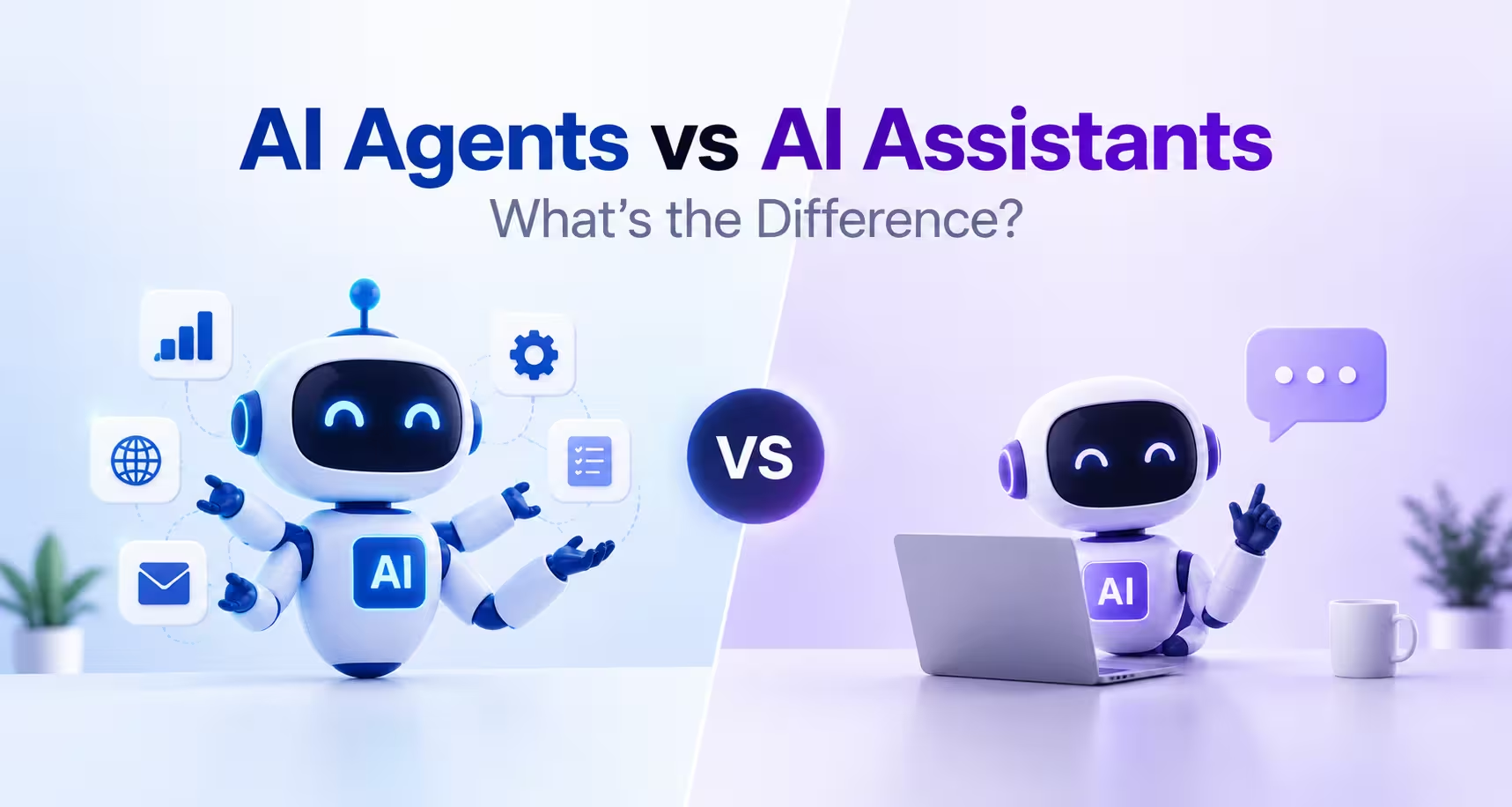
AI assistants and AI agents are becoming part of everyday work, but the two terms are often used as if they mean the same thing.
They don't.
An AI assistant is generally designed to help you with a task by answering questions, generating content, analyzing information, or providing suggestions.
An AI agent goes a step further. It can take a goal, decide what needs to happen, use available tools, and carry out multiple steps with less human input.
The difference might sound small, but it can have a big impact on how you use AI.
For example, you might ask an AI assistant: "Write an email to a customer about their delayed order."
It gives you the email.
An AI agent could potentially: check the customer's order, find the shipping status, determine what happened, draft an appropriate response, and prepare the email for approval.
One creates the answer. The other can potentially work through the process.
As AI becomes more capable, understanding this difference is becoming increasingly important for businesses, developers, marketers, and everyday users.
In this guide, we'll explain AI agents vs AI assistants, how they work, the key differences, real-world examples, and when you should use each one.
AI Agents vs AI Assistants: Quick Comparison
| Feature | AI Assistant | AI Agent |
|---|---|---|
| Answers questions | ✅ | ✅ |
| Generates content | ✅ | ✅ |
| Understands context | ✅ | ✅ |
| Uses external tools | Sometimes | Usually |
| Performs multiple steps | Limited | ✅ |
| Makes decisions | Limited | ✅ |
| Takes actions | Limited | ✅ |
| Works autonomously | Usually limited | More autonomous |
| Requires human input | Often | Can require less |
| Best for | Assistance & guidance | Task execution & automation |
The important word here is autonomy.
An AI assistant usually waits for you to tell it what to do next. An AI agent can potentially determine the next step itself.
What Is an AI Assistant?
An AI assistant is software that uses artificial intelligence to help you complete tasks or find information.
You've probably already used one. Chatbots, writing assistants, coding assistants, research tools, and voice assistants can all fall into this broad category. You ask a question or provide an instruction, and the AI responds.
Examples. You could ask an AI assistant:
- "Summarize this document."
- "Write a blog introduction."
- "Explain this error."
- "Give me five marketing ideas."
- "Translate this paragraph."
- "Create a social media caption."
- "Help me understand this code."
The assistant is useful because it reduces the effort required to complete the task.
But in many cases, you remain responsible for moving the workflow forward.
What Is an AI Agent?
An AI agent is an AI-powered system designed to pursue a goal through multiple steps.
Instead of simply responding to an instruction, an agent can potentially:
- Understand the objective.
- Create a plan.
- Choose the appropriate tools.
- Perform actions.
- Check the results.
- Adjust its approach.
- Continue until the task is completed or it needs human input.
For example, imagine you say: "Find three competitors for our product and prepare a comparison." An agent might:
- Search for competitors.
- Visit their websites.
- Collect pricing information.
- Compare features.
- Organize the information.
- Create a report.
The exact capabilities depend on the agent and the permissions you've given it.
That's an important point. Not every product calling itself an "AI agent" is truly autonomous. Some are simply AI assistants with a few additional tools.
The Simplest Way to Understand the Difference
Here's an easy way to think about it.
AI Assistant: "Tell me what you need help with."
AI Agent: "Tell me what outcome you want."
An assistant might help you complete individual steps. An agent is designed to potentially handle a larger workflow.
AI Agents vs AI Assistants: Real-World Example
Let's say you're running an online store. A customer sends this message:
"My order hasn't arrived yet. Can you check what's happening?"
Using an AI Assistant
You might give the message to your AI assistant. The assistant could suggest: "Ask the customer for their order number."
You then find the order, check the tracking information, and write the response.
The AI helped you.
Using an AI Agent
An agent connected to your ecommerce and shipping systems could potentially identify the customer, find the order, check the shipping status, determine whether the package is delayed, draft a response, offer an appropriate next step, and escalate the issue if necessary.
You might only need to review the final response.
That's the fundamental difference:
The assistant helps you do the work.
The agent can potentially do more of the work for you.
7 Key Differences Between AI Agents and AI Assistants
1. Autonomy
This is probably the biggest difference. AI assistants generally operate in response to your instructions. AI agents can potentially continue working through a task without needing a new instruction at every step.
Assistant: "Here's how you can analyze your competitors."
Agent: "I'll analyze the competitors and prepare the comparison."
2. Number of Steps
Assistants are often best for individual tasks. Agents are designed for workflows involving multiple actions.
Assistant: Write a product description.
Agent: Research the product → analyze competitors → identify benefits → write the description → create variations → prepare social copy.
The second workflow requires the AI to manage several connected steps.
3. Tool Usage
AI assistants may have access to tools, but AI agents are generally designed around tool usage. An agent could potentially interact with websites, APIs, databases, CRMs, email, calendars, files, code repositories, and business software.
The AI model decides which tool to use based on the task.
4. Decision-Making
An assistant usually provides information or suggestions. An agent may need to decide what to do next. For example: "The first API request failed. Should I retry?"
A more capable agent could potentially inspect the error, determine why it failed, and try another approach. That decision-making ability is an important part of agentic workflows.
5. Memory and Context
Both assistants and agents can use context, but agents often need more persistent context to complete longer workflows. For example, an agent working on a software project may need to understand project structure, previous changes, coding standards, existing bugs, test results, and user requirements.
The more complex the task, the more important context becomes.
6. Human Involvement
AI assistants usually involve humans more frequently. You ask. AI responds. You ask again. AI responds again.
Agents can potentially reduce that back-and-forth.
However, less human involvement isn't always better. For important tasks, humans should often remain in the approval loop.
7. Ability to Take Action
This is where the distinction becomes most practical. An assistant might tell you: "Your meeting is tomorrow at 10 AM."
An agent with calendar access could potentially find the meeting, check your availability, prepare notes, identify relevant documents, and create a task afterward.
The difference is between information and execution.
AI Assistant vs AI Agent Example by Industry
The difference becomes even clearer when we look at real workflows.
Marketing
AI Assistant: "Write five Facebook ad variations for this product."
AI Agent: "Create a campaign for this product."
The agent could potentially research the audience, generate copy, prepare creative ideas, organize campaign assets, and prepare everything for review.
Software Development
AI Assistant: "Write a Laravel controller for user registration."
AI Agent: "Add user registration to this application."
The agent could potentially inspect the project, modify routes, create controllers, update models, add validation, write tests, run the tests, and fix errors. The developer still reviews the result.
SEO
AI Assistant: "Give me keyword ideas for an AI tools website."
AI Agent: "Find new SEO opportunities for our website."
An agent could potentially analyze existing pages, identify content gaps, research keywords, compare competitors, and prepare a content plan.
Customer Support
AI Assistant: "Write a response to this customer complaint."
AI Agent: "Resolve this customer complaint."
The agent could potentially look up the customer's account, check the relevant order, determine the problem, prepare a response, and escalate the issue if necessary.
Sales
AI Assistant: "Write a cold email for this prospect."
AI Agent: "Research these prospects and prepare personalized outreach."
The agent could potentially research companies, identify relevant information, organize prospects, and prepare personalized messages.
AI Agents Don't Automatically Mean Full Automation
This is an important distinction. People sometimes hear "AI agent" and assume "the AI can do everything without humans." That's not necessarily true. There are different levels of autonomy.
- Level 1 — AI Assistant: The AI provides information. Human does the work.
- Level 2 — AI Copilot: The AI suggests actions. Human chooses what happens.
- Level 3 — AI Agent With Approval: The AI performs tasks but asks for confirmation before important actions. AI works → human approves.
- Level 4 — Autonomous Agent: The AI performs defined workflows with limited human involvement. AI works → AI checks → AI completes.
For most businesses, Levels 2 and 3 can be a safer starting point.
When Should You Use an AI Assistant?
AI assistants are often the better choice when you need:
- Quick Answers: If you simply need information, there's no reason to introduce an autonomous agent.
- Brainstorming: AI assistants are excellent for generating ideas and exploring different approaches.
- Writing: Emails, blog outlines, social posts, product descriptions, and drafts are ideal assistant tasks.
- Learning: If you're learning programming, marketing, SEO, or another subject, an assistant can explain concepts interactively.
- Decision Support: An assistant can help you compare options and identify potential risks without taking action itself.
When Should You Use an AI Agent?
AI agents become more interesting when the task involves:
- Multiple Steps: If you repeatedly perform the same sequence of actions, an agent may be useful.
- Multiple Applications: If your workflow requires moving between several systems, an agent can potentially coordinate them.
- Repetitive Research: Competitor research, lead research, reporting, and monitoring can be good candidates.
- Software Development: Coding agents can handle increasingly complex development tasks.
- Business Automation: Agents can potentially manage workflows that previously required significant manual effort.
AI Assistants Are Not Becoming Obsolete
It's tempting to think that agents will simply replace assistants. That's unlikely. There will always be situations where you don't want an AI to take action. Sometimes you just want an answer.
If you're asking "What is an API?" you don't need an agent.
If you're asking "Help me decide whether REST or GraphQL is better for this project," an assistant may be ideal.
If you're asking "Build the API, add authentication, write tests, and prepare the project for review," now an agent starts making more sense.
The important question isn't "Which is better?"
It's "Which level of autonomy does this task actually require?"
Benefits of AI Agents
- Save Time: Agents can potentially automate repetitive multi-step workflows.
- Reduce Manual Work: Instead of copying information between systems, AI can potentially handle parts of the process.
- Work Continuously: Agents can potentially monitor information or perform tasks outside normal working hours.
- Scale Workflows: One automated workflow can potentially handle many more tasks than a manual process.
- Connect Different Tools: Agents can potentially act as a layer between different applications.
Risks of AI Agents
The benefits are significant, but so are the risks.
- Incorrect Decisions: An agent can misunderstand a goal or make an incorrect assumption.
- Security Risks: Giving AI access to email, databases, customer information, or business systems requires strong access controls.
- Unexpected Actions: An agent with too many permissions can potentially make changes you didn't intend.
- Higher Costs: Long-running agent workflows can consume significantly more resources than simple AI conversations.
- Lack of Accountability: Businesses need to know who is responsible when an AI system makes an important decision.
This is why human oversight shouldn't disappear simply because AI becomes more capable.
Which Is Better for Business?
There isn't one universal answer. For many businesses, the best approach is actually a combination.
Use AI Assistants For: Writing, brainstorming, research, analysis, summaries, planning, decision support.
Use AI Agents For: Workflow automation, data processing, multi-step research, software development, customer support, lead management, repetitive operations.
The strongest setup may look like: Human → AI Assistant → AI Agent → Human Approval.
The assistant helps you think.
The agent helps you execute.
The human remains responsible for important decisions.
What Is the Future of AI Agents and Assistants?
The line between assistants and agents will probably become less obvious. Instead of having one separate "assistant" and one separate "agent," future AI systems may combine both capabilities.
You might start with a simple question: "How are our sales doing this month?" The AI answers.
Then you say: "Find out why sales dropped in the Middle East." The AI researches.
Then: "Create a report for the management team." The AI creates it.
Then: "Send it to the team." The AI prepares the email and asks for approval.
One conversation could move from assistant → researcher → agent → action.
That's where things get interesting.
Frequently Asked Questions
What is the difference between an AI agent and an AI assistant?
An AI assistant primarily helps users by answering questions, generating content, analyzing information, and providing suggestions. An AI agent is designed to pursue a goal through multiple steps and can potentially use tools and take actions with less human intervention.
Is ChatGPT an AI assistant or an AI agent?
ChatGPT can function as an AI assistant, while some ChatGPT workflows can also provide agentic capabilities. The distinction depends on what tools and actions are available in the particular experience.
Are AI agents better than AI assistants?
Not necessarily. AI agents are better suited to multi-step tasks and automation, while AI assistants are often better for quick answers, writing, brainstorming, and situations where you want to stay closely involved.
Can AI agents work without humans?
Some can operate with significant autonomy, but completely removing humans isn't always desirable. Sensitive or high-impact workflows should generally include approval and monitoring.
Are AI agents expensive?
They can be more expensive than simple AI assistants because agents may perform multiple model calls, use external tools, execute code, browse information, and run longer workflows.
Can AI assistants become AI agents?
Yes. The difference is often about capabilities and autonomy rather than the underlying AI model. An AI assistant can gain agent-like capabilities when it is given tools, permissions, memory, planning abilities, and the ability to take actions.
Will AI agents replace AI assistants?
Probably not. Both serve different purposes, and many future AI products will likely combine assistant and agent capabilities in one interface.
Should small businesses use AI agents?
They can, especially for repetitive workflows such as lead research, customer support, reporting, content operations, and data processing. However, businesses should start with low-risk tasks and gradually increase autonomy.
Final Thoughts
The difference between AI agents and AI assistants comes down to one simple idea: AI assistants help you with tasks. AI agents can potentially carry out tasks.
An assistant might explain how to solve a problem. An agent may be able to investigate the problem, use tools, make changes, and verify the result.
But more autonomy doesn't automatically mean better AI. For a simple question, an assistant is often all you need. For a complicated workflow involving multiple systems and repetitive steps, an agent can be much more valuable.
The smartest approach is to match the level of AI autonomy to the task. Don't give an agent permission to perform a high-risk action just because it can.
Start with simple workflows. Keep humans involved where mistakes matter. Measure the time saved and the quality of the results.
As AI continues to evolve, the most useful systems may not fit neatly into the category of "assistant" or "agent." They'll simply understand what you want, know when to help, know when to act, and know when to ask you first.
Want to explore the tools behind this shift?
At Aivellow, we're tracking this shift and making it easier to discover useful AI tools for productivity, coding, marketing, automation, research, and everyday work. Check out our What Are AI Agents guide, our AI Trends to Watch in 2026, and our full Top 25 Best AI Tools in 2026 guide. Browse our Best AI Marketing Tools and Best AI Productivity Tools guides, explore more by category, submit a tool we should feature, or get in touch if you have questions.