
Artificial intelligence has moved well beyond the chatbot phase.
A few years ago, most conversations about AI focused on generating text, answering questions, or creating an image from a prompt. In 2026, the more interesting story is what happens after the prompt.
AI systems are starting to search, plan, use software, write and test code, create video, hold natural voice conversations, and interact with the physical world.
That shift matters. The next stage of AI isn't simply about making models smarter. It's about making AI more useful, more autonomous, and more deeply connected to the tools and environments people already use.
Google describes 2026 as an "agentic era," while OpenAI's research on Codex points to a shift from short AI interactions toward longer tasks that can run for hours.
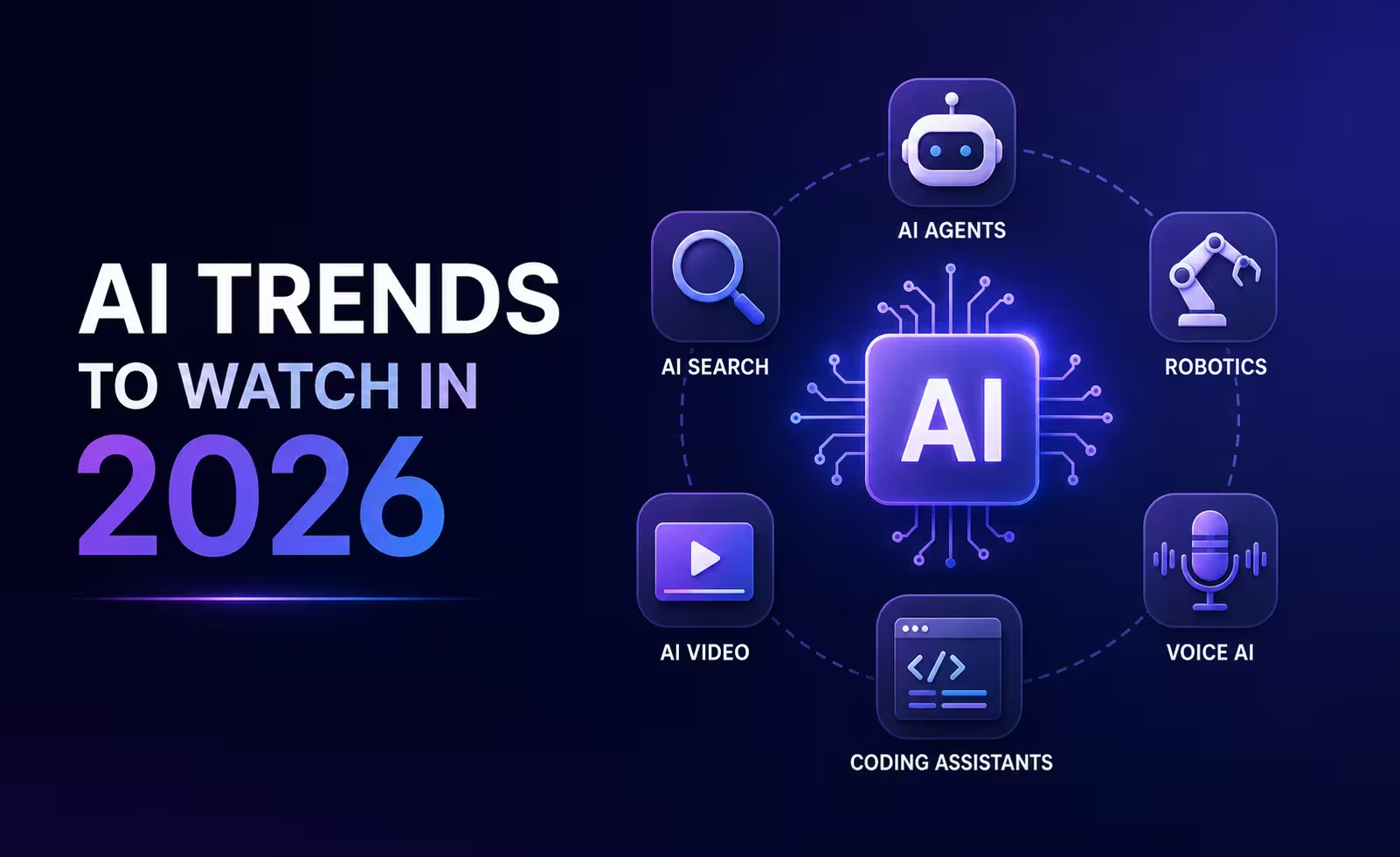
So, what should businesses, creators, developers, and everyday users actually watch? Here are six AI trends worth paying attention to in 2026.
The 6 Biggest AI Trends in 2026
| # | AI Trend | What's Changing |
|---|---|---|
| 1 | AI Agents | AI is moving from answering questions to completing tasks |
| 2 | Robotics | AI is moving from screens into the physical world |
| 3 | AI Search | Search is becoming more conversational and answer-driven |
| 4 | AI Video | Creating professional-looking video is becoming dramatically easier |
| 5 | Voice AI | AI conversations are becoming faster and more natural |
| 6 | Coding Assistants | Developers are delegating larger parts of software development |
These trends aren't completely separate. In fact, they're starting to overlap.
An AI agent might search the web, use a coding assistant, generate a video, talk to a customer through voice, or eventually control a physical robot. That's what makes 2026 particularly interesting.
1. AI Agents Are Becoming More Autonomous
From "Ask AI" to "Let AI Handle It"
This may be the biggest AI trend to watch this year.
Traditional chatbots wait for you to ask a question and then give you an answer. AI agents are different.
You give an agent a goal, and it can potentially break that goal into smaller steps, use tools, access information, execute actions, check its work, and continue until the task is completed.
Google's 2026 AI Agent Trends report describes this shift as moving from individual prompts toward systems that can orchestrate complex, end-to-end workflows.
OpenAI similarly describes agentic AI as changing knowledge work from short interactions to delegated, longer-running tasks. Its 2026 research on Codex found that users were increasingly giving coding agents tasks that could take a person more than an hour to complete.
What Can AI Agents Do?
Depending on the system, agents can help with tasks such as:
- Researching a topic
- Organizing information
- Managing documents
- Writing and testing code
- Analyzing data
- Monitoring systems
- Preparing reports
- Updating business software
- Handling repetitive workflows
- Researching leads
- Supporting customer service
The important difference is execution.
A chatbot might tell you how to update a spreadsheet. An agent could potentially update the spreadsheet itself.
Why This Matters
Imagine telling an AI: "Find the best five competitors in our market, compare their pricing, summarize their positioning, and create a report."
Instead of answering each step separately, an agent could potentially handle the entire workflow. That's a much bigger productivity improvement than simply generating text.
The Catch
Agents aren't magic. They can make incorrect decisions, use the wrong information, misunderstand instructions, or take an action you didn't intend.
The more autonomy an AI receives, the more important permissions, monitoring, security, and human oversight become. That's why the winning approach in 2026 isn't simply "give AI complete control."
It's: give AI enough autonomy to be useful, while keeping humans responsible for important decisions.
What to Watch
Watch for AI agents becoming:
- More reliable
- Better at using multiple applications
- Better at remembering context
- Better at long-running tasks
- Easier for non-technical users to configure
- More deeply integrated into business software
2. Robotics Is Bringing AI Into the Physical World
AI has spent most of its life inside computers. Robotics changes that.
Instead of AI simply generating an answer on a screen, physical AI allows machines to perceive their environment, make decisions, and perform actions. This is particularly visible in humanoid robotics.
In 2026, robotics is moving closer to early commercial deployment, although the technology is still far from the science-fiction version many people imagine. Research and industry reports point to progress in humanoids, embodied AI, healthcare robotics, logistics, manufacturing, and human-robot collaboration.
Why AI Makes Robots More Interesting
Traditional robots are usually programmed to perform specific tasks. AI-powered robots can potentially learn more flexible behaviors.
For example, instead of programming every possible movement required to pick up an object, an AI-powered robot could use vision and learned models to understand what it sees and determine how to interact with it. That opens the door to more flexible automation.
Where Robots Are Being Used
The most practical applications are likely to remain industrial and commercial for some time. Potential areas include:
- Warehouses
- Manufacturing
- Logistics
- Healthcare
- Retail
- Agriculture
- Inspection
- Delivery
- Dangerous environments
Autonomous robots are already operating in areas such as manufacturing, logistics, healthcare, and ports, while humanoid systems are moving toward early commercial applications.
Don't Believe Every Robot Demo
This is where it's important to separate progress from hype. A robot performing an impressive demonstration doesn't mean it is ready to work reliably in a factory for eight hours a day.
Current humanoid systems still face major challenges involving:
- Reliability
- Dexterity
- Battery life
- Safety
- Cost
- Real-world perception
- Generalization
- Maintenance
Recent demonstrations have shown impressive movement and dexterity, but also highlighted how difficult reliable real-world operation remains.
What to Watch
The most interesting development isn't necessarily a robot that looks human. It's a robot that can reliably perform useful work. Watch for progress in:
- Robot foundation models
- Vision-language-action models
- Dexterous manipulation
- Warehouse automation
- Industrial robots
- Healthcare robotics
- Human-robot collaboration
- Physical AI
3. AI Search Is Changing How We Find Information
Search is going through one of its biggest changes in decades. For years, the basic search experience was: type a query → get links → open websites → find the answer.
AI search is changing that flow. Now you can ask a much more detailed question and receive a conversational response that combines information from multiple sources.
Google has continued expanding AI Overviews and AI Mode throughout 2026. Google says AI Mode has surpassed one billion monthly active users globally, while AI Mode queries have been growing rapidly.
Search Is Becoming More Conversational
Instead of searching "best laptop 2026," people can ask:
"I'm a freelance developer who travels frequently. I need a lightweight laptop with strong battery life, enough performance for development, and a budget of $1,500. Which options should I consider?"
That's a completely different type of search. AI can understand the context behind the question and help narrow down the answer.
What This Means for Websites
This trend matters enormously for publishers and SEO professionals. Getting a page onto the traditional first page of Google is no longer the only goal.
Websites increasingly need to become sources that AI systems can understand, trust, and reference. That means:
- Original research matters
- Clear answers matter
- Strong expertise matters
- Structured content matters
- First-hand experience matters
- Brand authority matters
- Accurate information matters
Google itself has been adding ways for AI Search to surface original content, relevant websites, and direct links within AI-generated responses.
AI Search Isn't Replacing the Web
This is an important distinction. AI search still needs websites. AI systems need information to summarize, compare, verify, and cite.
The bigger change is how people discover those websites. Instead of ten blue links being the entire experience, search increasingly becomes a conversation that leads people toward sources.
What to Watch
Expect AI search to become:
- More conversational
- More personalized
- More multimodal
- Better at research
- More capable of taking actions
- More connected to shopping
- More connected to websites and apps
For website owners, SEO is becoming less about ranking for one keyword and more about becoming a trusted source of information.
4. AI Video Is Moving From Experiment to Production
AI-generated video has changed quickly. Not long ago, AI video often produced strange movement, inconsistent faces, distorted objects, and clips that were obviously machine-generated.
The quality gap is narrowing. By 2026, tools such as Google Veo, Runway, Kling, and other video-generation systems are producing increasingly realistic video and becoming part of real creative workflows. Industry coverage of the 2026 AI-video landscape points to significant improvements in realism, motion, consistency, and production usability.
What AI Video Can Do
Modern AI video tools can help with:
- Text-to-video
- Image-to-video
- Scene generation
- Video editing
- Background replacement
- Visual effects
- Product videos
- Social media clips
- Storyboards
- Concept visualization
- AI avatars
Why This Matters for Creators
Traditional video production can be expensive. You may need cameras, lighting, locations, actors, editors, animators, voice talent, and multiple shooting days.
AI doesn't eliminate all of those needs, but it can dramatically reduce the cost of certain types of production.
A small business could create a product video without renting a studio. A YouTuber could generate supporting visuals for a video. A filmmaker could test a scene before shooting it. A marketer could create several creative variations for an ad campaign.
But AI Video Still Has Problems
AI video isn't perfect. Common challenges include:
- Character consistency
- Exact object placement
- Physics
- Long-form continuity
- Fine control
- Copyright questions
- Brand consistency
- Cost at scale
The best workflows often combine AI generation with human editing rather than asking AI to create an entire finished production.
What to Watch
The next major improvements are likely to involve longer clips, better character consistency, better physics, better audio, more precise editing, multi-shot storytelling, real-time generation, and AI video agents.
The most important shift isn't simply "AI can make a video." It's: AI can become part of the entire video production workflow.
5. Voice AI Is Becoming More Human
Text is not the only way to interact with AI anymore. Voice AI is becoming faster, more natural, and more capable of understanding interruptions, context, emotion, and conversational timing.
In May 2026, OpenAI introduced new real-time voice models designed for reasoning, translation, and transcription while people speak.
OpenAI has also described newer voice systems using full-duplex interaction, allowing the model to listen and speak at the same time rather than relying on rigid turn-taking. That may sound like a small technical improvement. It isn't.
Why Conversation Quality Matters
Human conversation isn't: person speaks → AI waits → AI answers → person speaks.
People interrupt. They pause. They change their minds. They say "actually, forget that." They laugh. They think while the other person is speaking.
For voice AI to feel genuinely useful, it needs to handle those things naturally.
Where Voice AI Is Going
Expect voice AI to become more common in:
- Customer service
- Personal assistants
- Language translation
- Education
- Accessibility
- Sales
- Healthcare interfaces
- Automotive systems
- Call centers
- Voice-controlled software
Real-time translation is another important area. New voice systems are increasingly able to translate speech while maintaining conversational flow.
Voice Agents Could Be Huge
Imagine calling a company and speaking to an AI that can actually understand your problem, access your account, check availability, make a change, process a request, and escalate the issue when necessary.
That's much more useful than a voice bot that simply reads a menu.
The Challenge
Voice AI raises serious questions around identity, consent, voice cloning, fraud, privacy, recording, and deepfakes.
As voice becomes more realistic, businesses will need better authentication and provenance systems.
What to Watch
Look for real-time voice agents, multilingual conversations, better interruption handling, voice-controlled software, AI phone agents, voice cloning safeguards, and real-time translation.
6. AI Coding Assistants Are Becoming AI Coding Agents
AI coding assistants started with autocomplete. Then they learned to generate functions. Then they started explaining code and fixing bugs. Now the trend is moving toward agents that can handle much larger software-development tasks.
This may be one of the most important changes for developers in 2026.
OpenAI's Codex research found that users are increasingly delegating longer tasks to coding agents, while JetBrains reported that 90% of surveyed professional developers were using AI coding agents at work at least weekly during May–July 2026, with 68% using them daily.
What Can Coding Agents Do?
Depending on the tool, an AI coding agent can read a repository, understand project structure, write code, modify multiple files, run commands, run tests, debug failures, create pull requests, refactor code, write documentation, and investigate issues.
That changes the developer's role. Instead of saying "Write this function," you might say:
"Add authentication to this application, update the database schema, create the required API endpoints, write tests, and explain any security decisions."
That's a much higher-level request.
Does This Mean Developers Are Going Away?
Not so fast. AI can write code quickly. That doesn't mean it understands your product perfectly.
Developers still need to make decisions about architecture, security, performance, data models, scalability, testing, user requirements, and maintainability.
The more powerful AI becomes, the more valuable technical judgment becomes.
The Developer Workflow Is Changing
A future workflow might look like: developer defines the problem → AI agent plans the implementation → AI agent writes the code → AI agent runs tests → developer reviews the result → AI agent fixes issues → developer approves deployment.
The developer becomes less of a typist and more of a technical director.
What to Watch
Expect coding agents to become more autonomous, better at large repositories, better at testing, better at debugging, more integrated with Git, more capable of working in parallel, and better at understanding project standards.
OpenAI's Codex platform, for example, is already being positioned around parallel agents, long-running tasks, code review, CI/CD, and background engineering work.
How These Six AI Trends Connect
The most interesting thing about 2026 isn't any single technology. It's how these technologies are starting to connect.
Imagine a business launching a new product. An AI agent could:
- Research competitors using AI Search.
- Create a marketing strategy.
- Generate a landing page with a coding agent.
- Create promotional videos using AI Video.
- Generate voiceovers using Voice AI.
- Automate customer support using another AI agent.
- Eventually connect those digital systems with physical robotics.
That's very different from the AI experience of a few years ago.
AI is moving from a tool you ask questions to toward infrastructure that can participate in workflows.
What These Trends Mean for Businesses
Businesses shouldn't chase every new AI trend. That's an easy way to waste money. Instead, look for areas where AI can solve a real bottleneck.
- Customer Service: Voice AI and agents can handle repetitive customer interactions while escalating complicated cases to humans.
- Marketing: AI search, video generation, voice, and content tools can reduce production time.
- Software Development: Coding agents can help teams build, test, document, and maintain software faster.
- Operations: AI agents can connect different systems and automate repetitive processes.
- Manufacturing: Robotics and physical AI can gradually automate tasks that are difficult to handle with traditional software.
The key is to start with the problem rather than the technology.
What These Trends Mean for Creators
Creators have another interesting opportunity. A small team can now access capabilities that previously required multiple specialists.
One creator can use AI Search for research, ChatGPT for planning, AI coding tools for websites, AI image generators for visuals, AI video generators for footage, Voice AI for narration, and AI agents for repetitive tasks.
That doesn't mean creativity becomes less important. It means the cost of turning an idea into something real can become much lower.
What These Trends Mean for Developers
Developers are likely to feel the impact particularly strongly. The biggest change isn't that AI can write code — AI has been doing that for years. The bigger change is that AI can increasingly handle longer sequences of development work.
That means developers may spend less time on boilerplate, documentation, basic tests, repetitive refactoring, simple bug fixes, and routine scripts.
And more time on architecture, product decisions, code review, security, system design, and AI orchestration.
The ability to work effectively with AI agents is likely to become an important development skill.
The Biggest AI Trend of All: AI Becomes Less Visible
Here's a prediction worth watching. The most important AI products may eventually be the ones where you don't even think about AI.
You won't necessarily open an "AI app." Your email will automatically organize itself. Your calendar will protect focus time. Your development environment will detect a bug and prepare a fix. Your search engine will research a complicated question. Your customer service system will handle routine conversations. Your video editor will find the best clips. Your business software will automatically complete repetitive workflows.
In other words: AI may become less of a destination and more of a layer underneath everything else.
That's probably a more important shift than any individual model release.
Should You Start Using These AI Trends Now?
You don't need to jump into all six. Start with the area closest to your current work.
- If You Run a Business: Start experimenting with AI agents and automation.
- If You're a Developer: Explore coding agents.
- If You're a Creator: Try AI video and voice tools.
- If You Do SEO or Marketing: Pay close attention to AI Search.
- If You Work in Manufacturing or Logistics: Watch robotics and physical AI.
- If You Build Customer-Facing Products: Explore voice AI.
The best early adoption strategy is simple: choose one real problem, test one AI solution, and measure the result.
Frequently Asked Questions
What are the biggest AI trends in 2026?
The biggest trends include AI agents, robotics and physical AI, AI-powered search, generative video, real-time voice AI, and agentic coding assistants.
What are AI agents?
AI agents are systems that can take a goal, plan multiple steps, use tools, and execute tasks with varying levels of human supervision. They are moving beyond simple question-and-answer interactions toward longer workflows.
Will AI agents replace employees?
AI agents are more likely to automate specific tasks and workflows than replace every employee outright. However, some jobs and responsibilities will change significantly as AI becomes capable of handling larger portions of knowledge work.
Is AI Search replacing Google?
AI is changing Google Search rather than simply replacing it. Google's AI Mode and AI Overviews are increasingly combining conversational answers with links and web content.
Is AI video good enough for professional use?
For many applications, yes. AI video quality has improved significantly, particularly for short-form content, advertising concepts, product visuals, social media, and creative experimentation. However, human editing and creative direction remain important for consistent professional production.
Will humanoid robots become common in 2026?
Humanoid robotics is moving toward early commercial applications, but widespread household adoption is still a long way off. Current systems continue to face challenges involving cost, reliability, safety, dexterity, and real-world autonomy.
What is the future of voice AI?
Voice AI is moving toward real-time, natural conversations where systems can listen, reason, translate, and take actions during a conversation.
Will AI replace software developers?
AI coding agents will automate more development tasks, but software engineering still requires architecture, security, testing, product understanding, and human judgment. Developers who learn to effectively supervise and collaborate with AI are likely to have an advantage.
Final Thoughts
2026 feels different from the early days of generative AI. The question is no longer simply "What can AI generate?" The more interesting question is "What can AI actually do?"
AI agents are beginning to perform tasks. Robotics is bringing AI into the physical world. AI Search is changing how we find information. Video models are making production more accessible. Voice AI is making conversations feel more natural. Coding agents are taking on increasingly large pieces of software development.
None of these technologies is finished. There will be failures, hype, bad products, security problems, and plenty of exaggerated predictions along the way. That's why it's worth paying attention without blindly believing every headline.
The companies and individuals that benefit most from AI won't necessarily be the ones using the most tools. They'll be the ones that understand where AI genuinely creates value and where human judgment still matters most.
Want to keep up with what's next in AI?
At Aivellow, we're tracking the tools and technologies shaping this next stage of AI. Check out our full Top 25 Best AI Tools in 2026 guide, our Best AI Coding Assistants and Best AI Video Generators guides, or our ChatGPT vs Claude vs Gemini comparison. Explore more by category, submit a tool we should feature, or get in touch if you have questions.